Tourist & Resident Guide to Iran

Sunday, September 03, 2006

Images: Ancient History of Iran

Images: Ancient History of Iran


A huge variety of bric-a-brac is on display at Tehran's Jomeh Bazaar (Friday Market). Iran's last monarch and his wife are pictured here among the antiquities - very much part of the past.

Shah's coronation photos, Jomeh Bazaar

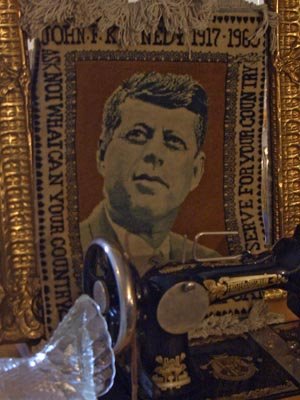
Another iconic figure of the 20th century, this time commemorated on a specially woven Persian rug.

JFK carpet

Tehran Sightseeing Guide

© Iranvisitor.com

Monday, August 21, 2006

Iran's Fuel Leak Naghadeh

Iran’s Fuel Leak Naghadeh


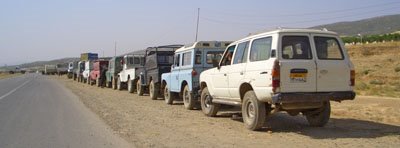
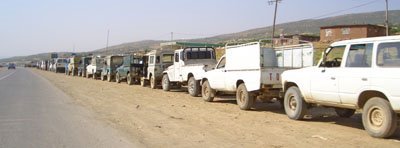
gasoline queue, Naghadeh

The twelve-pump state-owned filling station in Tehran’s Velenjak suburb had never seen a queue like this. Though constantly and doggedly jammed with an irreconcilable jumble of aging Paykan taxis, family-owned Kia Prides and sleek German status-mobiles, there is never more than a 20-minute wait.

But here in Naghadeh, West Azerbaijan, it was nearly a kilometre before any indication of the petrol station could be seen above the roofs of the jeeps and pickups that filed motionless down the dusty highway. There was, however, no sign of unrest. The drivers, resigned to spending the day here, either slept or chatted and shared tea and melons in the shade.

The complete absence of regular city cars at this local filling station told the whole story. Naghadeh, situated southwest of salt-infused Lake Urumieh, is a prime filling point for gasoline smugglers. The nearby border with Iraq has become porous since US forces handed control over to Iraq's own forces four months ago. All of these sturdy, hard-working vehicles will take their full tanks west into Iraq and then finally to Turkey where petrol prices are ten to fifteen times more expensive than at Iranian pumps.

No greater irony can exist in oil-rich Iran than a shortage of petrol. Iran consumes 70 million litres of petrol per day while its refineries produce only 40 million – making Iran a net importer of petrol despite having the world’s third largest oil reserves.

The causes are well-known and endemic. Government subsidies keep pump prices down to as low as 800 Rials ($0.09) per litre which encourages wasteful consumption and provides an incentive for smugglers.

Government plans to curb this problem through rationing have been shelved due to the absence of a framework to track consumption and the general public’s heavy over-reliance on private cars and taxis. Indeed it is hard to imagine car-clogged Tehran taking rationing or a hike in petrol prices lying down.

Shortages, intolerable waits and empty pumps have motivated Naghadeh residents to pre-empt the national government in taking action. They have forced local lawmakers to accept a rationing system of their own design. Computer systems which track the registration numbers of vehicles coming to local pumps have been supplied and programmed entirely at the expense of private citizens. Motorists are now limited to one full tank every three days. Since most smugglers try to make one trip per day, this measure is set to cut queues significantly.

Nevertheless, this local measure is unlikely to be a precursor to any national efforts. While oil revenues continue to be buoyed by soaring prices, Iran will not be forced to take any painful measures to ease its dependence on imported petrol. For the meantime at least, it can afford to feed its unhealthy addiction by providing the rest of the world with the raw materials to feed their own.

Guide to Tehran

© Iranvisitor.com

Saturday, August 19, 2006

Azadi Monument Tehran

Azadi Monument Tehran


Tehran's most famous architectural symbol is the Azadi (“Liberty”) Monument in Azadi Square. It was constructed in 1971 as part of Mohammad Reza Shah’s celebrations to commemorate 2,500 years (by his own count) of Persian monarchy and was hence named the Shahyad Tower. It was given its current name after the 1979 revolution which saw all indications of the former regime stripped from streets of the city.

The 50m tower, clad entirely in cut marble, is said to combine Islamic architecture and the earlier Sassanid style. Situated near Mehrabad Airport, it was the first sight to welcome visitors to Tehran for many years before international flights were recently redirected to the new Imam Khomeini Airport near Qom.

The basement floor houses a museum and cultural centre and the roof can be accessed by elevator. Though it retains great affection among Iranians, the Azadi Tower is now in competition with the 435m Milad Tower for its place as the symbol of the city.

Azadi Tower.

Azadi Tower.

Azadi Tower.

Guide to Tehran

© Iranvisitor.com

Friday, August 04, 2006

Iran Images: Resistance Stations in Vanak Square

Iran Images: Resistance Stations in Vanak Square


At major pedestrian and traffic intersections around the city of Tehran, makeshift shelters have been set up to spread the anti-Israeli message. If there was any ambiguity about the position of the government of the Islamic Republic of Iran regarding Israel, there can be no doubt about it now - "Israel must be wiped out [sic] the world".

Resistance Station, Vanak Square

Resistance Station, San'at Square

Photographs of Iran

© Iranvisitor.com

Wednesday, August 02, 2006

Images: More Pro-Hezbollah Propaganda

Images: More Pro-Hezbollah Propaganda

The pro-Hezbollah propaganda machine goes into overdrive in Tehran.

Seyyed Hassan Nasrallah

Hassan Nasrallah pictured in the rear windscreen of a Pride hatchback.

Hassan Nasrallah

Photographs of Iran

© Iranvisitor.com

Saturday, July 29, 2006

Images: The Smiling Face Of Anti-Zionism

Images: The Smiling Face Of Anti-Zionism


anti-Zionist window sticker
Snapped on the windscreen of a bus in Northern Tehran. The avuncular Sayyed Hassan Nasrallah, Lebanese leader of Hezbollah, smiles on warmly as his men march off to war with the "illegitimate Zionist entity".

Photographs of Iran

© Iranvisitor.com

Thursday, July 27, 2006

Mountain Walk at Darakeh

Mountain Walk at Darakeh

Summer turns Tehran into a white hot pit. And in much the same way as one places rocks around a fire, the mountains around the city seem to focus all the heat into the centre. Thankfully, they also provide sun-stricken city-dwellers with paths up to cooler climes. Deprived of altogether less wholesome entertainments, one of Tehran’s most popular weekend activities for all ages is “kuh raftan” – going to the mountains.

There are three main paths into the mountains in the north of the city where Tehranis flock at weekends.

TOCHAL

I used to go here a lot. It’s an easy walk from where I live and – smog allowing – you get amazing views of the city but that’s about all it’s got going for it as far as I’m concerned. In winter, skiers and snowboarders from Tehran’s wealthier communities drive up the broad path to the first station where they take the telecabin (cable car) to the high peaks. In summer though, the shadeless, dusty, flat track is hardly inviting during the daytime and who wants to go mountain climbing at night? Plenty of Iranians seem to, however, many stopping at the broad asphalt plateau at the first station to drink tea out of plastic cups and some at the surreally located paintball range which seems to have landed from another planet on the otherwise bare slope.

view of Tehran smog from Tochal

DARBAND

I’ve only been here once – and even then I didn’t go far up. From what I saw, this is easily the most commercially developed of the three. The narrow path that follows the cascading river is flanked on both sides with unbroken ranks of restaurants and coffee-houses, mostly quite large, with countless carpeted daises. Multicoloured fluorescent tubes and globes light up the white stucco crenellations of these establishments make the whole place look like a mountain-themed amusement park. Good place for a first date.

DARAKEH

By far the most appealing to nature lovers and the closest you’ll get to a genuine hike without leaving the city. The path starts in the narrow streets of an aged suburb shaded by tall plane trees and cut in two by a gushing stream that accompanies the walking path all the way up to near the peak. Unlike Tochal, the path never gets wide enough to allow more than four people to walk abreast and, for a city defined by indecorous driving, it’s refreshing to find that Tehranis are perfectly civil when faced with heavy pedestrian traffic.
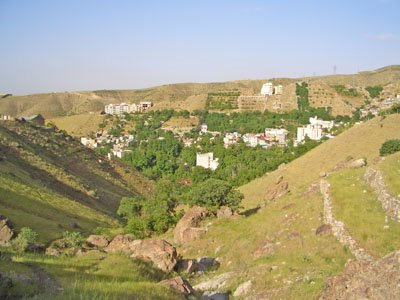
The suburb of Darakeh
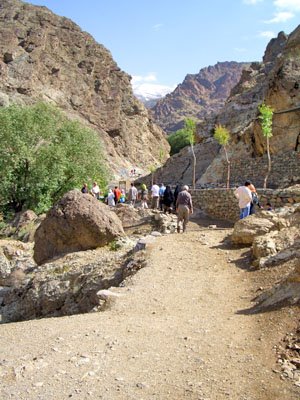
mountain path at Darakeh

Pretty soon after leaving the last of the suburban residences behind, you can see families and groups of friends picnicking in shady spots by the wayside. Groups of schoolgirls maqne’eh tight, huddled around a secret. Lads lying out, using each other as pillows and passing the gheliyun. Some stop at the teahouses which stud the path until about two hours in, where old plane and walnut trees give their shade generously and you can order tea, dates and adasi (lentil soup).

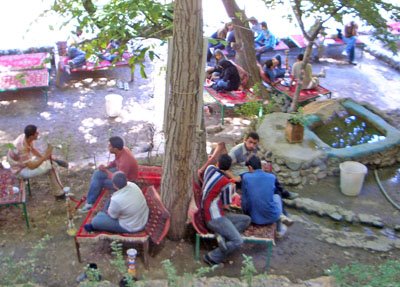
Darakeh
Darakeh Coffee Shop (but everyone drinks tea)

The path is rocky and challenging enough in places to make the unaccustomed huff and puff. But that doesn’t deter a handful of specialist traders from making up a scattered, eclectic bazaar on the earlier sections of the mountain path. For instance, the dervish who sells organic cotton garments and imported Indian throws from his cliff perch, and the bookseller with his modern Persian classics and translations of Western philosophers. They and the kamancheh player who busks for change in front of the bookshop add their spiritual spice to the sunglasses and hat sellers and snack vendors.
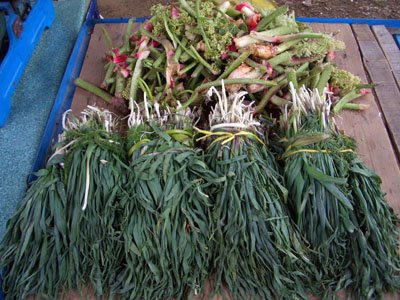
mountain herbs for sale

Having passed the stalls selling plump black cherries and pulpy mulberries we now see the orchards from which they came, the parasitic city now left far behind. Energetic teenagers try their height, jumping up at the branches which hang over the wire fence, their upper reaches still fully laden but the ground now covered with the stains of fallen fruit. We are now in productive lands. The crowds thin out slowly as you get higher but Iranians are quite prepared to carry full picnic sets including rugs, kettles, portable barbecues and gheliyuns in their tight-packed rucksacks quite a way up the mountain path. Once they’ve found the perfect spot by the riverbank, they may take the opportunity to pick the pungent wild herbs that grow there, cool their feet in the icy water or just savour the freshness of the air and the sound of the water, perhaps forgetting, just for a moment, exactly which city it is they’re from.

Darakeh Valley

Tehran Sightseeing Guide

Saturday, July 22, 2006

Quotes: A Hard Act To Follow

Quotes: A Hard Act To Follow

Quotes: A Hard Act To Follow

"You can't force people to believe that, simply because the representative of God has died, the man now sitting in his chair is the new representative of God."

--from "In The Rose Garden Of The Martyrs" by Christopher de Bellaigue

Buy In The Rose Garden Of The Martyrs by Christopher de Bellaigue from Amazon
USA
UK
Japan

Friday, June 23, 2006

Quotes: The Importance of Carpets

Quotes: The Importance of Carpets

The Importance of Carpets.

"To us, a carpet is a vital necessity. You spread a carpet on a wretched, parched desert, lie down on it, and feel like you are lying in a green meadow."

--a carpet seller in Ryszard Kapuściński's "Shah of Shahs"

© Iranvisitor.com

Visitor's view: Interpretations of hejab

Visitor's view: Interpretations of Hejab

The reception girls never turn up before 9. That means I’m in there with my thoughts for about 30 minutes before the school wakes up.

Interpretations of Hejab


They have to wear the “maqne” because we are an educational establishment and have some small but important part to play in maintaining society’s values. For a woman, normal streetwear must include a headscarf tied over the hair and this is open to a range of interpretations.

It's pretty safe to judge who you can and who you mustn't chat up by how much hair a girl reveals. The maqne is the headdress of the education system and the office. It reveals the face, it frames the face, it isolates the face. It is impossible to look coquettish in a maqne. No woman would wear one as a matter of personal preference.

It is about as far as the authorities will push liberal-minded women to observe the dress code – force them to wear the less revealing, less comfortable covering in formal settings. And chador-wearers always wear chadors. It is hard to imagine, and it is seldom seen, that a tent- wearer (another common usage for the word “chador”) walk down the street with another wearing the hejab to a lesser degree of diligence. Never mind a fashion statement. Iranian women wear political statements.

© Iranvisitor.com

Book Review: Shah of Shahs

Book Review: Shah of Shahs

By Ryszard Kapuściński

Mohammad Reza Pahlavi, the last Shah of Iran, embarks on an ill-considered push towards modernization, fuelled by oil wealth and driven by a greed for admiration. Kapuściński recalls photographs, using them as cross-sections of history’s great worm through time. Here, Reza Pahlavi, the Shah father, is pictured with his young son. They wear identical uniforms. The symbolism is powerful and entirely intended.

Book Review: Shah of Shahs.
Lacking entirely the iron resolve of the first Shah, Mohammad Reza could only inhabit indolently the high life of palace and ski slope. Kapuściński, in his mind, interviews the young Shah for Hello! magazine. “The most difficult thing to do while living in a palace is to imagine a different life – for instance, your own life, but outside of and minus the palace.” And so further and further he detached himself from the people he ruled over, though never forgetting to lash out at them from afar, consciously or unconsciously aping his paternal role model.

Iran too has its own psyche and hang-ups. The unconscious rural poor are irreconcilable with the Pahlavi ego, keen to strive forward. And the rebellious streak in Shiism means that Iranians are never sad to see their Shahs’ heads fall. One of the most delightful moments in this book is when the author conjures up the first Shiites’ teaching Iranians that “you can be a Muslim without being an establishment Muslim… you can be an opposition Muslim! And that makes you an even better Muslim!” “Shiism”, he later defines is “a form of national survival” but he does not face head-on the brooding spectre of Ayatollah Khomeini in his reckonings. The rise of the Islamic Republic only proves that “it is not always the best of men who emerge from hiding.”

In one of the longest sections of the book, Kapuściński turns novelist and tells of the first tentative words of opposition in the fashion of a Dostoevsky, but instead of a murderer as a subject/protagonist, he follows a returned émigré intellectual who witnesses the beginnings of unrest but remains in denial, running in fear from SAVAK. Then from the novel to the theatre. Kapuściński goes on to portray the Shah as an incompetent director using vast amounts of “imported scenery” for his play, “The Great Civilisation” – an absurdist piece in which, against his wishes, the extras tear down the stage at the end.

A veteran of political unrest (by his own count, Iran was his 27th revolution) journalist Ryszard Kapuściński leads us on an impressionistic journey through the roots in history and psychology of the players right up to the tipping point “when the policeman shouts but the man doesn’t run.” His observations weave the mundane with the profound to achieve drama, involvement and even comedy. Clearly appreciating the Python-esque surrealism, he includes, from an Iranian newspaper, an interview with a professional “wrecker of the Shah’s monuments” who unwittingly tells the story of the last Pahlavi monarch through that of his own travails with rope and hook.

“––Does that mean you would pull down, he would set up, then you would pull down what he set up, and it kept going like this?
––That’s right. Many times we nearly threw in the towel. If we pulled one down, he set up three.”

Will Yong

Buy Shah of Shahs by Ryszard Kapuściński from Amazon
UK
Japan

© Iranvisitor.com

Tuesday, May 23, 2006

The Azari Traditional Teahouse Tehran

Azari Teahouse Tehran

One of the best places in Tehran for a “traditional” Iranian dining experience.

The Azari Traditional Teahouse
Azari teahouse

Sweet, hospitable smells of flavoured tobacco waft through its beautifully-restored patterned brick façade. The atmosphere is everything at this superbly executed establishment and a warm greeting from the staff tells you that considerate service has also been brought into the mix – an important factor in a place so ideal for foreign visitors.

Pass the local men filling the brightly-lit café-style antechamber with scented smoke and then through to the courtyard. The high, peaked canvas roof, propped up by its sturdy pole rather gives the impression of a luxurious tent. The central pool and creeping plants further add to the outdoor feel.

Guests either doff shoes and sit on a carpeted dais or huddle around tables. Little fluted glasses of tea are set on saucers with a satisfying clunk almost as soon as you are seated. Closely following are plates of succulent dates and soft, freshly-baked cookies. The food, though limited to a choice of fried freshwater fish, chicken kabāb or ābgusht, is of a high standard. The waiters, in traditional dress, are very polite and will serve and set to work mashing your abgusht with a flourish.

Though there was a time that even traditional forms of music were considered “haram” (i.e. against God’s will) and banned in the Islamic Republic of Iran, now things are considerably more relaxed. One night’s entertainment at the Azari consists of 3 different musical acts.

On the night we visited we were greeted by the well-intentioned chanting of a folk singer accompanying himself with a hand drum. His style of singing is still employed in the training centres of the Pahlavan, Iran’s traditional wresters and body-builders.

He was followed by an ensemble of kamancheh, santour, daf and vocalist performing traditional songs quite professionally, if not very enthusiastically. The final duo, however, made up for any deficit. The poker-faced deadpan of the santour player could not prepare us for the lightning speed and bravado of his playing and the singer/daf-player gave it all he had.

It would be hard to find a better combination of traditional setting, cuisine and music than at the Azari, anywhere in Tehran.

Location: Southern end of Vali-e Asr Avenue near the central Railway Station.
Tel: 021 55373665

Guide to Tehran

© Iranvisitor.com

Sunday, May 14, 2006

Carpet Museum Tehran

Carpet Museum Tehran


Not far from the Museum of Contemporary Art and also adjacent to Laleh Park, the Carpet Musuem of Iran is one of the most rewarding to visit of Tehran's many museums.

Most of the carpets on display are from the 19th or 20th centuries but there are a handful of older specimens from as far back as the 16th century.

Contrary to information provided in the Lonely Planet: Iran, photography is permitted though use of flash is not.

Hunting and wildlife scenes show off the carpet makers art to the greatest extent.

Carpet Museum, Tehran

Look at the dynamism of the animals and birds among the swirling floral design of this carpet.

Carpet Museum, Tehran

Some of the more abstract geometric motifs reminded me strongly of Native American patterns.

Carpet Museum, Tehran

Carpet Museum, Tehran

The “Tree of Life” is a common motif in Persian painting as well as carpets.

Carpet Museum, Tehran

This “Tree of Life” design incorporates portraits of dozens of important personages throughout history…

Carpet Museum, Tehran

…including a very gruff-looking Queen Victoria.

Carpet Museum, Tehran

Here is a carpet depicting the impressively-moustachioed Shah Abbas the Great of the Safavid Period.

Carpet Museum, Tehran

Tehran Sightseeing Guide

© Iranvisitor.com

Monday, May 08, 2006

The Tehran Museum of Contemporary Art

The Tehran Museum of Contemporary Art

On the west side the very lovely Laleh Park is a low-lying dun-brick building functioning as Tehran’s most important museum of contemporary art.

In the construction itself you see something of the struggle in all Iranian art to reconcile the traditional with the modern. First notice the skylights raised from the roof. Reminiscent of the “badgirs” of Yazd or Kashan, these allow the harsh sun to softly light the central sunken well of inner space – itself a modern interpretation of the cool underground havens of desert city residences.

Labyrinthine corridors spin off the central hall and guide you through the history of modern Iranian art. There are many fine pieces and some deep, absurdly comfortable armchairs from which to view them from.

Here are some of the pictures I took before I was caught on one of their countless security cameras.

This is one of the museum’s most impressive calligraphic works. Swathes of tightly packed Arabic script radiates out from an unfathomable centre. A profound message of divine unity. I will have to make another trip to note the name of the artist.

Tehran Museum of Contemporary Art

Another by the same artist.

Tehran Museum of Contemporary Art.

And this is just gorgeous.

Tehran Museum of Contemporary Art

Guide to Iran and Iranian Culture

© Iranvisitor.com

Thursday, April 27, 2006

MAHAK – Iranian Cancer Charity for Children

MAHAK – Iranian Cancer Charity for Children

The Society to Support Children Suffering from Cancer, known as MAHAK, is a strictly non-governmental organisation founded in 1991 by socially motivated volunteers. The main objective of this Society is to alleviate pain in children suffering from cancer and bring hope to their devastated families.

During the past fourteen years, MAHAK has helped more than 8000 cancer-stricken children all over the country as well as the children of Iraqi and Afghan refugees.

MAHAK has recently achieved one of its main objectives and constructed its own specialised Mega Hospital and Rehabilitation Complex in Tehran with the ability to provide care for 120 children with accompanying parents.

The complex is designed to offer treatment and a range of rehabilitation possibilities beside other facilities such as an auditorium, a playground and dining hall.

In order to find out more about the society, please visit www.mahak-charity.org

Cancer is not only painful, but also costly

Currency Account No.: 140056 BANK SADERAT Branch #1445
TEHRAN_IRAN, SWIFT: BSIRIRTHAGHM

Currency Account: Bank Saderat, Regional office, Main Branch: 125050
United Arab Emirates (U.A.E.), Dubai, SWIFT: BSIRAEAD

Contact information

PO BOX: 19395-5445, Tehran, Iran
Email: info[at]mahak-charity.org
Telephone: (+98 21) 2249 0544
Fax: (+98 21) 2244 5454

Thursday, April 20, 2006

Book Review: All The Shah's Men

Book Review: All The Shah's Men

By Steve Kinzer

All The Shah's Men.

Iran's recent development of uranium enrichment facilities has been referred to in the official national media as an event even more significant than the nationalisation of the oil industry in 1951. But while borrowing the historical imagery of Iran's first great victory against imperialism, nothing is said by the country's leaders of the man who led the charge, Mohammad Mossadeq.

"All The Shah's Men" is a pulsating account of the rise of this champion of Iranian nationalism, his nationalisation of the oil industry and his subsequent downfall at the hands of the CIA in 1953 that shows just how big a part US foreign policy played in the creation of a "rogue state". This book is essential reading for understanding the combination of reverence and injustice that many Iranians still feel having been robbed of their great nationalist hero, and why Iran's current regime now has no place for him in their own national mythology.

Kinzer paints a sympathetic picture of this man who coughed blood seemingly as a direct consequence of the injustices that the British were being allowed to perpetrate in his country through the Anglo-Persian Oil Company (later, the Anglo-Iranian Oil Company and later still, British Petroleum). For a people raised on the idea of personal martyrdom, the fainting fits, coughing blood and involuntary tears of this highly emotional character all added to his popular appeal.

Since oil had been discovered in Iran by British engineers in 1908, the Anglo-Persian Oil Company (later, the Anglo-Iranian Oil Company and later still, British Petroleum), had become one of the key elements of the Empire. Safeguarding oil supplies ran parallel with protecting the entire imperial ideology whose foundations in monopolising the riches of other countries had already begun to look tenuous. Thus, to arch-imperialists such as Churchill and Eden, Mossadeq was a man who might have brought down an empire.

Across the Atlantic, two radically different ideologies were doing battle over how best to approach the threat of Communism. While Truman had thought it best to ride the wave of nationalist movements and help them to stand independently against the red tide, the incoming Eisenhower administration preferred a more "hands-on" approach. The British knew that the fear of Communism could drive the incoming president to extreme action and it was their encouragement that paved the way for the birth of the regime change rationale that was to characterise much of US foreign policy in the decades that followed.

Complete with its swashbuckling anti-hero, CIA agent, Kermit Roosevelt, at the helm of anti-Mossadeq operations on the ground, Kinzer's book reads more like a spy thriller with political punch than it does a straightforward history. And it is indeed the good-natured ease with which he approached his job that highlights just how callous an approach to world politics his masters in Washington were taking. Covert action seemed, at the time, to be a satisfyingly direct and cost-effective device to ensure a more favourable regional situation, it is clear that with the Islamic world currently rising up in anger against US heavy-handedness, the real price of the coup is clearly still being paid.

Following the story of this national hero to its conclusion in the Mossadeq family estate where he spent his final years under house arrest, Kinzer gives touching accounts of the quiet memories that still echo around the village to which he was kind patron and generous benefactor. There is no escaping the question of what might have been if he had been allowed to lead the whole of Iran. What could have been if the British hadn't been so intransigent, if the Truman doctrine had not given way to Eisenhower. If a national hero had been allowed to rule the country that had wanted him, that needed him and who had elected him.

Buy All The Shah's Men by Steve Kinzer from Amazon
USA
UK
Japan

© Iranvisitor.com

Friday, April 07, 2006

National Museum of Iran

National Museum of Iran, Tehran


The National Museum of Iran is an archaeological and history museum in central Tehran and preserves some of the world's most valuable Persian antiquities.

The collection is a must-see on any visit to Tehran. The museum opened in 1937 and the building housing the pre-Islamic period collection was designed by French architect Andre Godard and is modeled on a Sassanian palace.

The National Museum of Iran is actually made up of two separate buildings: Godard's building contains pre-Islamic period exhibits, the second building next door (opened in 1996) consists of the post-Islamic collection - Islamic period art, books, calligraphy, carpets, ceramics, miniatures and textiles from over 1000 years of the Muslim history of Iran.

The collection of ancient Persian art contains pieces from Shush, Persepolis, Ismail Abad, Rey and Turang Tappeh.


Relief Sculpture, National Museum of Iran, Tehran
National Museum of Iran, Tehran © Camille-Hélène Lemouchoux
Statue, National Museum of Iran, Tehran
National Museum of Iran, Tehran © Camille-Hélène Lemouchoux

Details

National Museum of Iran

Open 9 am-1 pm; 2 pm-4 pm
Closed Tuesday
14-16 672061-6 Emam Khomeini Avenue,
Si-e-Tir corner, Tehran
Tel: 620 2061
www.nationalmuseumofiran.ir

© Iranvisitor.com

Tuesday, April 04, 2006

Noruz Table

Noruz Table


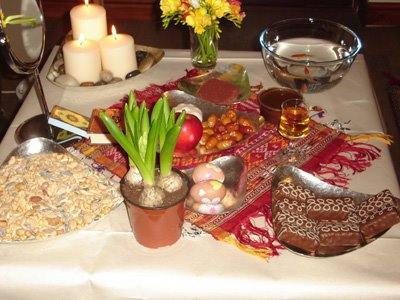
A traditional Noruz table (Sofreh haft-seen) consists of seven kinds of food, each beginning with the letter S or sin in Farsi, which represent the virtues of abundance, health, life, love, patience, purity and wealth.

Noruz table

Sabzeh - wheat or lentil sprouts symbolizing rebirth.
Samanu - a creamy wheat germ pudding with sacred connotations.
Seeb - apples represent beauty and good health.
Senjid - dried fruit of the lotus tree symbolizing love.
Serkeh - vinegar represents longevity and the virtue of patience.
Sir - garlic symbolizes good health due to its medicinal properties.
Somagh - sumac berries symbolize the brightness of the sun and the ultimate victory of good over evil.

Noruz table

Flowers such as hyacinths Sonbol and tulips Laleh can also be placed on the Noruz table and represent Spring.
Painted eggs are symbols of fertility.
The mirror represents the life reflected, candles reveal happiness and goldfish symbolize life and energy.

Images kindly provided by Mohammed, an Iranian Msc student at Metropolitan University, London

Iranian food

© Iranvisitor.com

Wednesday, March 29, 2006

Skiing in Iran

Skiing in Iran


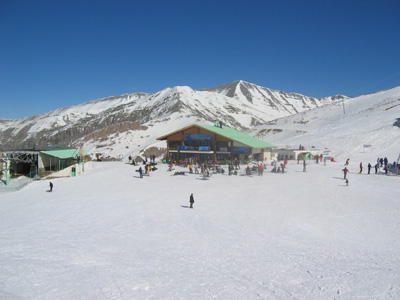
There are a number of excellent skiing resorts in Iran, mostly in the Alborz mountains to the north of the capital, Tehran, though there is also piste near Kermanshah and Tabriz.

Ski Resort, Alborz Mountains

The sport was introduced to Iran in the 1930s by German railway workers and often taken up by returning Iranian expats from Europe. In 1947 the Iranian Ski Federation came into existence. Iranian skiers now regularly compete at the winter Olympics.

Skiing was initially prohibited after the 1979 Revolution but was allowed again in 1988. Costs are minimal if you have the equipment (though everything can be hired at the resorts) and the season in the Alborz mountains lasts from November to the end of March.

Mount Damavand, Alborz Mountains

The slopes nearest to Tehran will be packed now at Dizin, Tochal, and Shemshak for Noruz.

Iranian Ski Federation

© Iranvisitor.com

Monday, March 20, 2006

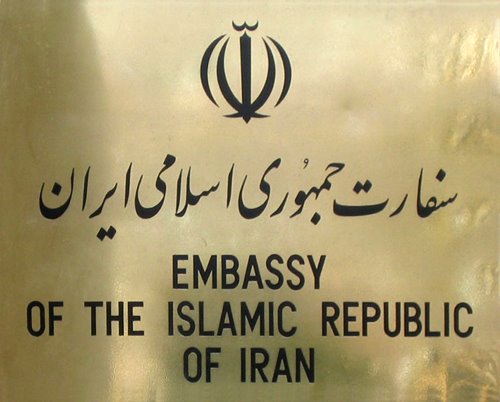
Iranian Embassy in London

Iranian Embassy in London

Iranian Embassy

Iranian Embassy in the United Kingdom
16 Prince's Gate
London SW7 1PT

The nearest underground station to the embassy which overlooks Hyde Park is Knightsbridge on the Piccadilly Line.

Iranian Embassy

© Iranvisitor.com

Thursday, February 16, 2006

Saturday, February 11, 2006

Islamic Revolution Day

Islamic Revolution Day


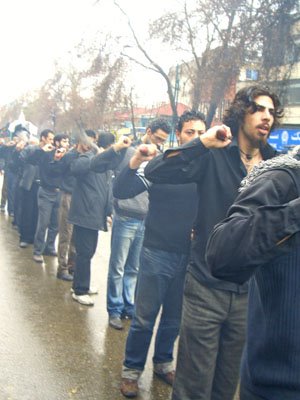
Today, February 11 is the 27th Anniversary of the Islamic Revolution in Iran when Ayatollah Khomeini came to power in 1979 and is celebrated as a national holiday.
In The Rose Garden of the Martyrs - Buy this book from Amazon

Other national holidays in Iran are:

Oil Nationalization Day - March 20
This day celebrates the nationalization of the Anglo-Iranian Oil Company in 1951.

Noruz - around March 21-24
Iranian New Year "Noruz" (lit. new day) is celebrated on the Spring Equinox and many Iranian return to their home towns during this period.

Islamic Republic Day - April 1
The anniversary of the beginning of the Islamic Republic.

Sizdah Bedar - April 2
This is the 13th day of the Persian new year when many Iranians leave their homes and go on picnics to avoid bad luck.

Heart-Rending Departure of the Great Leader - June 4
The anniversary of the death of Ayatollah Khomeini in 1989.

Anniversary of the Arrest of Ayatollah Khomeini - June 5
The anniversary of the arrest of Ayatollah Khomeini in 1963, when he urged Muslims to revolt against the superpowers.

Anniversary of the Death of Dr. Seyed Behesthi - June 28
The anniversary of the death of Dr. Seyed Behesthi, a key Khomeini ally in 1981. Behesthi was killed by a bomb blast, along with 72 other people, at a meeting of the Islamic Republic party.

Day of the Martyrs of the Revolution - September 8
The anniversary of the deaths of several hundred people killed when Iranian troops fired on a Tehran demonstration against the Shah in 1978.

Religious Holidays

Iran also has many religious holidays which are celebrated on dates according to the Muslim lunar calendar.

In The Rose Garden of the Martyrs - Buy this book from Amazon
USA
UK
Japan

© Iranvisitor.com

Saturday, February 04, 2006

Iran's Oil Industry Blood & Oil

Iran's Oil Industry

Blood & Oil

Iran is the world's fourth-largest producer of crude oil. In 2002 Iran produced approximately 3.72 million barrels per day (Mbbl/d). It is estimated that Iran has the second-largest reserves of untapped petroleum in the world, (125.8 billion barrels) second only behind Saudi Arabia (260 billion barrels). Iranian reserves amount to one-tenth of the world's estimated total supply. Iran also has estimated reserves of 940 trillion cubic feet of gas about 16% of total world reserves.

Petroleum production has been the main industry in Iran since the 1920s. The oil industry was nationalized in 1951 with the then government forming the National Iranian Oil Company (NIOC). Petrochemical exports now generate about US$1 billion dollars a year with major trading partners being China, India and Japan. In 2003, the vast majority (about 90%) of oil exported from the Persian Gulf was carried by tanker through the Strait of Hormuz.

In 2003, Iran announced the discovery of the world's second largest oilfield near the Persian Gulf port of Bushehr with an estimated reserve of 38 billion barrels.

Guide to Tehran

Blood and Oil: The Dangers and Consequences of America's Growing Dependency on Imported Petroleum by Michael T Klare

Buy this book from Amazon
UK
Japan

© Iranvisitor.com