Tourist & Resident Guide to Iran
Showing posts with label Iran. Show all posts

Monday, January 26, 2026

Iranian Music: Daf

Iranian Music: Daf

The daf (Persian: دف), also known as dâyere or riq, is a traditional Iranian frame drum used in both popular and classical music. It is widely played across Persian-influenced regions of South and Central Asia, including Iran, Afghanistan, Azerbaijan, Tajikistan, Uzbekistan, parts of Georgia and Armenia, Pakistan, and areas of India.

The daf.

The daf is the other of Iran’s indigenous drums – the other is the donbak which I've already talked about elsewhere.

As you can see from the picture, the daf is a wide, circular, frame drum. Inside the frame of the drum are hundreds of metal rings in short chains. The player beats the drum with his fingers while supporting it in his palms.

With the movement and beating of the daf, the rings inside the frame strike the skin – the same way as the springs of a snare drum work. The sound is a combination between a bass boom caused by the hand and a high-pitched crash from the rings. The daf is a drum for dancing to. Indeed, it is the drum to which Sufi mystics dance the whirling, trance-inducing dance known as sama.

© Iranvisitor.com

Thursday, September 29, 2011

Vakil Bazaar Shiraz Iran

Vakil Bazaar

Vakil Bazaar in Shiraz is the city's main market and located in the historic heart of the old city.

Child's Dress, Vakil Bazaar, Shiraz

The market is thought to date from the 11th century and is a good place to buy Persian carpets, ethnic clothes (as pictured), copper ornaments, and local herbs and spices. nearby are a number of mosques, bathhouses, and caravanserais.

Photographs of Iran

© Iranvisitor.com

Sunday, June 26, 2011

The Provinces of Iran

The Provinces of Iran

Iran has 31 provinces or ostan each governed by a provincial governor-general. Sistan and Baluchistan is the largest Iranian province by area, slightly bigger than Kerman. Tehran is the largest by population by some distance and has the highest population density.

The Provinces of Iran

The provinces are further divided into counties (shahrestan), and then subdivided into districts (bakhsh) and sub-districts (dehestan).

Esfahan

Iran's 31 Provinces

Alborz, Ardabil, Bushehr, Chaharmahal and Bakhtiari, East Azerbaijan, West Azerbaijan, Fars, Gilan, Golestan, Hamadan, Hormozgan, Ilam, Isfahan, Kerman, Kermanshah, Khuzestan, Kohgiluyeh and Boyer-Ahmad, Kurdistan, Lorestan, Markazi, Mazandaran, North Khorasan, Razavi Khorasan, South Khorasan, Qazvin, Qom, Semnan, Sistan and Baluchestan, Tehran, Yazd, and Zanjan.

Iranian Music CDs

Books on Iran

Guide to Tehran

© Iranvisitor.com

Tuesday, March 02, 2010

People You Think You Know

People You Think You Know


I am making a documentary movie about Iran, its culture and its relationship to the West through an intimate portrait of one Iranian family in the diaspora.

You can watch web episodes I've made here (http://www.peopleyouthinkyouknow.com/) and learn more about my goals from my fundraising page here.

It would be wonderful if you could help me spread the word about my fundraising drive in any way you can, Alborz Kamalizad


Monday, February 02, 2009

Hosein Kaffash

I

The street was already clear from yesterday’s snow though patches still reflected luminous white from the bare earth of the mountainside. The brushes, tins, knives and rubber heels in Hosein’s wooden cart rattled as its wheels stuttered over the gravel left behind from the salt trucks. A Peykan taxi trundled past in low gear, pulling its thick steel carcass up the hill without complaint like a passive mule. Snow had again not been forthcoming this year, the extended autumn was proving as dry and bright as the summer. Though his grandfather’s orchard in the north had been sold long ago, out of habit, Hosein wondered whether the mild winter would snap suddenly and decisively like the year before and throttle the unripe fruit of the orange trees.
Up ahead, a four-wheel drive attempted a handbrake turn but could only manage a disappointing two metre skid, grinding the gravel into the unrelenting asphalt with a scrape. The gleaming hulk sped away and Hosein could again hear the rattle which attended the wheels of his hand-built cart. He neared the corner where the street turned back on itself and climbed further up the mountainside. He stopped and felt a breeze, chilled by the snowy peaks above, waft down and touch the light sweat on his forehead. He closed his eyes, breathed, and frigid air stung a little on the inside of his sinuses. “Allah-e Shokr”, he whispered to himself, moved by the alternate sensations of heat from the pale winter sunlight and the ripples of cold in the air.
On the last Friday of every month, Hosein the Kaffash brought his work up to this pleasant part of town, perched high on the Tochal foothills, detached from the polluted inner-city air. The neighbourhood knew him well enough by now for many of the residents of the forty or so low-rise apartment buildings to keep any shoes in need of repair at home, anticipating his next visit, rather than carry them to Tajrish Square where two other cobblers plied their trade on the steps by the bank.
Hosein turned and saw that his son had fallen some way behind. “Ali-jaan, come to daddy, come on!” At his father’s call Ali broke into a staccato run. Thick layers of clothing under his puffer jacket made it difficult for his arms to swing and he held them out stiffly to his sides, the yellow woollen bobble on his winter hat bounced with each tiny stride. Now nearly seven years old, Ali was old enough to accompany his father on his Friday rounds, a convenience which gave father and son their only prolonged contact during the week and Mariam some respite at home, though for this Hosein sacrificed his day of rest.
Hosein the kaffash knelt down in front of his son from whose mouth steam-laden breath was pumping out in short gusts. His wide, pebble-black eyes blinked twice and opened to their widest and the boy smiled as Hosein pulled off his hat, dried off his hot brow with a gloved hand and ruffled his son’s matted hair.

Hosein Kaffash

II

Ali stood mutely observing a mean-looking black and white tomcat while his father climbed the steps of another of the three-storey blocks. The cat pleaded at regular intervals with a persistent howl issuing from the depths of unfulfilled hunger and lust. A middle-aged woman with no headscarf appeared at a second floor window to toss down a plastic bag of chicken bones. The bones half spilled onto the paving stones and the sound of the mesh screen sliding shut scratched the prevailing hush. Hosein rang the first floor buzzer and could hear the cat pawing at the plastic bag for a few seconds before the click of the intercom and a woman’s voice.
“Yes?”
“Good morning miss, I’m the kaffash. If you have any shoes to shine or repairs for me I’m at your service.”
“Oh, I see…. Let me ask my husband… Mehrdad!”
Another click and the intercom fell silent. Hosein rang the second and third floor buzzers but no answer came to disturb the greedy, hollow sound of the cat’s hard teeth on bare bones. Hosein shifted his cart into a bright triangle which the sun threw over the steps up to the entrance. From it he withdrew a tattered square of coarsely woven stuff cut from the thick material of a motorcycle saddlebag which he placed on the first step where he would sit. A man he recognised from previous visits emerged wearing a long overcoat over a casual t-shirt carrying a pair of black leather shoes in one hand.
“Salaam Agha, I’m sorry but it’s just these today. You repaired them the last time you were here, may your hands not hurt! If you could just shine them for me and leave them inside the front door when you finish.”
He handed the shoes down from his place on the landing and opened his wallet. He drew out a crisp two thousand toman note and both men’s eyes held the folded blue rectangle for a shared moment from opposite sides of a great divide.
“It has no value, I’m at your service.” Hosein offered his ta’arof, the ritual refusal to be payed, but the money was already in his hand. The shoes had lost little of the shine that Hosein himself had put on them a month before and with every stroke of his brush he fought off the sense that he was in league with the mendicant accordian players and street sweepers who rang the same doorbells for small change. His eyes narrowed on the smudged outline of his own face which was beginning to emerge on the shoe in his blackened hand.
The door of the next block opened and an amply-proportioned female form emerged, draped in a pale grey floral print chador. She edged sideways to plant her feet on the first step, directly opposite where Hosein was sitting, one hand holding the moulded concrete bannister and the other cradling a tray against her bosom.
“Ali, go and help the lady. Quick!”
Without a word, the boy ran to the bottom of the steps, slipping and saving himself from a fall with both his hands. He beat his gloves free of the still fresh snow.
“Careful now, Ali.” Hosein observed the handover with as much care as the woman and young Ali executed it. “May your hands not hurt, you’ve made so much effort, thank you ma’am. Say thank you Ali,” to which Ali responded with a straightforward, “merci.”
“Oh, it’s nothing, I’m so ashamed,” the woman replied with a self-deprecating chuckle. She had a round face and a turned up nose. With her arms concealed under her grey chador she looked comically like an owl. “I’ll ask my grandson if he has any work for you,” she said.
Calling on Imam Ali for strength, the old woman hauled herself back up the steps with the same determined effort with which she had descended. Hosein rested the tray on his wooden cart and as father and son shared the unfamiliar tasting food, the relentless mewing of the vagrant black and white cat began once again. Hosein tossed him a scrap which did nothing to silence him.

© William Yong, 2009

Friday, January 09, 2009

Short Cuts: Ta'arof

Short Cuts: Ta'arof

The two men ordered their kebabs and the waiter motioned for them to sit at a simple formica table. The tiny kebab restaurant was busy this evening on the eve of Eid-e Ghadir.

Outside the first snow of the year was falling gently on the glossy black streets. One of the men adjusted the position of a steel frame chair and sat. It was a tactical slip which allowed his friend to open the play in a classic ta’arof gambit.

Short Cuts: Ta'arof

“Right, so why don’t I go next door and get us some fresh juice, what’ll you have?”

Taken by surprise, the seated man had no option but to come back at his friend with a rather cliched rejoinder, “thank you sir, but please be my guest.” His predictably vain attempt to get up and beat his opponent to the door was stopped by his friend’s outstretched arm.

“Come now, I won’t hear of it, let me this time, melon? pomegranate? These are on me,” the standing man said as he turned and made for the exit. Perhaps his move for the door was a fraction of a second premature.

“Ok, ok,” the seated man replied, seeing that the only way to keep his chances alive now was to feign surrender and come back with a different approach, “I’ll come with you, I can’t decide what I want until I see what they have.”

The two exited the restaurant together. Both men fingering their wallets.

(c) William Yong

Thursday, October 23, 2008

Thursday Night at the Bakery

Thursday Night at the Bakery

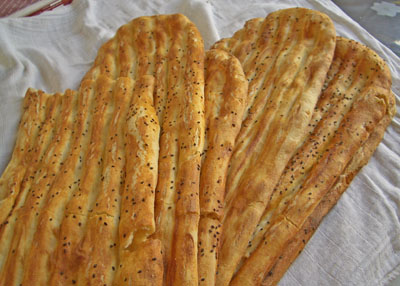
I'm sitting on the step in the last of the evening light, waiting in a queue of around five. It’s mostly men in the evenings, wives will be at home preparing dinner. It’s also the first day of the weekend, so tonight, demand for fresh “naan sangak” - a wholesome flat bread cooked on hot pebbles - is high.

barbari bread

Little brother scoots past my knees carrying a bundle of separated newspaper pages, ready for customers to grab to wrap their hot bread. The family business starts from the littlest one up on this Thursday evening shift. Inside, a boy not much older retrieves the cooked bread on a spatula as it appears on the revolving stone plate which carries them through the oven. The lad’s stout frame suggests he’s the older brother of the chubby little newspaper boy. His advantage in years puts him one step closer to the production end of the family business.

At peak times you won’t find a single Tehran bakery without waiting customers spilling into the street outside. Mass-produced bread is available at supermarkets but the reaction at home when you bring back a still-warm armful from the local bakers’ speaks of a link between man and his staple food that plastic packaging somehow comes between.

There’s a dull clang of wood on metal as the twenty-year-old baker’s apprentice drops the long palette handle into its holder. Even before it stops rattling his hands are in the aluminium trough to grab another slick, wet pat of dough. He’s the hard-running fly-half of the operation, the living link between the raw stuff and the furnace. If he wants to run his own bakery one day he’s got to serve his time at the oven door.

While the midfield dynamo continues to hum, the master baker’s assured eyes are on the doorway, watching the fading light of the evening. He’s transferring the last of the dough from the big aluminium mixer to the trough for the apprentice to work with. Pulling out a larger lump of the gloopy raw stuff than I think two hands can handle, I worry that the dough which is lolling over and around his wrists, is going to fall onto the floor. But his hands know the consistency of the stuff of his trade better than that. They guide the lump into the half-empty trough and it falls in with a slap.

The lanky understudy with his Roman nose watches as the master baker gives his last orders and departs. I imagine the young man's thoughts are on the possibilities of the weekend as he continues to eye the doorway with his hands in the dough.

“How many do you want?” the apprentice asks a youth standing in line.

“Seven,” the boy answers. He’s no more than a teenager but the stains on his clothes, tanned neck and arms and world-weary expression suggest he’s already spent more than a little time working to pay his keep. Perhaps he’s one of the hundreds of young men who dig around in trash cans to collect recyclable materials for cash.

“You can have seven ‘nun-e salavati,’” the apprentice motions to the pile of bread kept aside for those who don’t have the money to pay.

“No,” the boy answers stoically.

“Take them, they’re fresh,” the apprentice insists. According to Iran’s tradition of ta'arof a genuine offer is never made only once.

But with an upward nod of the head which Iranians employ to express an outright objection, the pauper boy insists the issue is closed. He turns his back and rejoins the rest of the customers waiting in line.

Iranian Music CDs

Guide to Tehran

Azari teahouse

© Iranvisitor.com

Monday, January 21, 2008

God mourns for the Imams?

God mourns for the Imams?


"Faith in the imams cures cancer and makes the lame walk… I’ve seen it with my own eyes, you’ve all seen it too"

The little man with the microphone. Unshaven, wearing a faded mismatched suit. Reminded me of snake oil sellers in Western movies. Do Iranians really hold beliefs so out of step with the given scientific mindset of the times? This was a speaker to the masses. He appeared to know his audience, and the 1000 toman notes were flowing.

God mourns for the Imams?

From what I can gather, the folk legends surrounding the Imams arise from more sources than one. There is the history. Events of the time are well documented and acknowledged also by Sunnis but this only provides the barest framework. Woven into the history are parables of the strength of Abol Fazl, the moral uprightness of Hossein, the justice of Ali – superhuman qualities all, but imams are not messengers of God and nor are they miracle workers. This is one essential aspect of Shiism which suggests roots in something other than Islam.

Maybe the key can be found in the stories of pre-Islamic heroes, Rostam and Siavash. Stories which are, at heart, legends from Zoroastrian times handed down through Ferdosi’s Shahnameh. Perhaps the habit of eulogizing heroes simply got transferred. Another sign of non-Islamic influence is the imagery – fantasy portraits of the Imams, full-bearded but with glowing almond eyes, almost feminine – an unquestionably Persian beauty.

“the earth, the heavenly sphere, time itself are mourning for the Imam. Even He, yes HE is mourning for the Imam with all his angels”

The little man continued his amplified lament, bent forward, with knees bent and free hand appealing to the sky, the ground, his heart, the crowd. God mourns for the Imams? In Christianity God allowed his son to die on the cross but in Shiite Islam he weeps for Hossein. The Imams are not prophets, not messengers of God but heroes, and their powers are still felt in everyday life. Ronaldinho may belong to Jesus but Iranian weightlifter Rezazadeh pledges allegiance to Abol Fazl on his chest. The exclamation “Ya Ali!” is heard whenever an Iranian faces an out of the ordinary situation and needs help – our equivalent would be “God help me!” but critically, the Shiite version doesn't appeal to a God but a long dead mortal.

Iranian Music CDs

© Iranvisitor.com

Friday, December 21, 2007

Cave of the Martyrs

Cave of the Martyrs

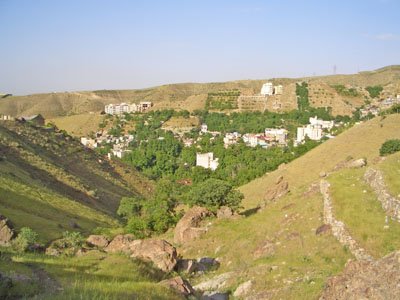
For the last few months I've been wondering what the green halogen lights leading up the mountainside were for. Alien landing site? Late night mining operations? There was nothing obvious from down below but one day I noticed a new street sign pointing up the hill. The white on brown colour scheme denoting something of cultural interest.

Cave of the Martyrs
Cave of the Martyrs
A thin layer of crisp snow lay on the ground the morning I decided to make my way up. I followed the icy dirt path in unsuitable shoes. Paw tracks showed me that the local strays had been up and down before dawn. A long, white goods container had been deposited on a level area half way up. Green-painted frame borders with "Kahf al-Shohada" (Cave of the Martyrs), brushed on in vivid blood-red spoke of the grief-fuelled nationalism so fundamental to current power structures. Open air martyr-worship in a country where the politico-religious establishment has a strict monopoly on public expression.

Further up was a slightly wider but equally anticlimatic plateau. More red, white and green. Iranian flags, makeshift spotlighting planted in the ground at incongruous angles. I heard the creak of a hinge and shuffling behind me and a lanky, young Basij boy, crewcut, unshaven, with regulation Palestinian check scarf, emerged from apparently nowhere. An inner voice told me my presence was not wanted. I swung my camera behind my arm offered a guilt-ridden "good morning." Political repression clearly having left its mark on my conscience.

Cave of the Martyrs
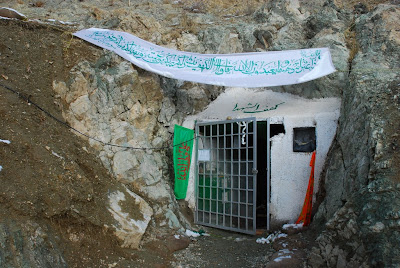
The great irony being that though this makeshift monument was intended as a form of public relations, the Basij themselves would be exceedingly sensitive to anyone here taking pictures of it for wider consumption. But the earnest young lad just returned my greeting and went on his way and he was safely out of sight before I ventured a look in the direction from where he had appeared. A workmanlike iron gate, banners with religious slogans hanging limp either side and above it. An entrance to a cell adapted from a natural cave in the mountainside.

Tehran, Iran.
Cave of the Martyrs
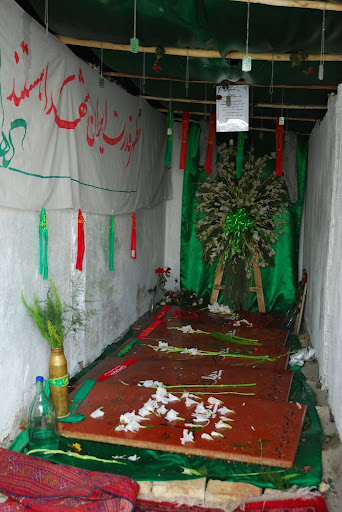
Inside, fading bouquets, petals strewn over three stone slabs laid on the ground. Graves of fallen heroes? An ascetic hermit's cell set aside for solitary mourning and devoted tears.

A few metres away, a low semicircle of sandbags, arranged like a machine-gun bunker, marked off the dead-end path. It guarded a crudely hung nylon banner. On it, a photograph showing Ayatollah Ali Khamenei, standing in reflective mood at the entrance to that very cave.

My cousin later told me of how his father rose early one morning for a mountain walk and witnessed the Supreme Leader emerging from "Kahf al-Shohada" under the cover of the half-light. No fanfare, minimal entourage, perhaps a very personal pilgrimage - but not without leaving photographic evidence to establish the site's status in Basij mythology.

Cave of the Martyrs

© Iranvisitor.com

Saturday, May 12, 2007

More Japanese Visit Iran in 2007

More Japanese Visit Iran in 2007


More and more Japanese are planning to visit Iran in 2007, according to PressTV.

More Japanese Visit Iran in 2007

More Japanese Visit Iran in 2007

More Japanese Visit Iran in 2007


Guide to Tehran

Thursday, March 08, 2007

Post Office Vali-Asr Square

Post Office Vali-Asr Square, Tehran

Post Office, Vali-Asr Square.
Iran’s postal service is reliable and efficient. Sending packages internationally requires identification in the form of a passport. Bring your package unsealed as contents will be checked before dispatch.

© Iranvisitor.com

Wednesday, February 07, 2007

Remembering the Martyrs of the Iran-Iraq War

Remembering the Martyrs of the Iran-Iraq War

Remembering the Martyrs of the Iran-Iraq War.

The scars of a war as devastating as the Iran-Iraq War (1980-1988) do not easily heal. Some counts put the number of Iranian casualties 300,000 with another 500,000 wounded. The number of Iraqi dead numbered around 375,000.

The Iranian establishment refers to the war as the “Iraq-imposed war” and Iran’s part in it is known as the “Sacred Defense”. Hence, Iran's war dead are shahid (martyrs). Shiite Islam, so steeped in the culture of mourning, gives them a place alongside the paradigmatic holy victims; Imam Ali and Hossein.

Tehran is dotted with large painted murals commemorating the most famous of the Iraq war martyrs. Their fixed gazes tell nothing of the conflict that robbed them of their lives. The colours have faded with time but their complexions remain unaging.

Remembering the Martyrs of the Iran-Iraq War.

Guide to Tehran

© Iranvisitor.com

Tuesday, January 30, 2007

Ghaliyan

Ghaliyan


The Ghaliyan - or hookah as it is more widely known - is a water pipe used for smoking tobacco. Ghaliyan is still very much a part of popular culture in Iran – in fact you see more young people smoking it than old. You can smoke ghaliyan at working-class teahouses and at traditional restaurants where it is served to your table or rug with dates, sweets and of course tea. Places like these quickly fill with the sweet aroma of scented tobacco. Many Iranians – especially young men – bring their own on mountain walks and picnics, take coals from the barbecue and share a smoke after lunching on chicken kababs.

Hookah pipe in Iran
The pipe consists of several parts; a glass jug part-filled with water, a wooden, earthenware or metal stem fitted tightly to the jug, a brazier at the top of the stem for coals and tobacco and a hose with a mouthpiece attached to the jug above water level.

When you suck the mouthpiece, air is drawn past the coals in the brazier and this heats the tobacco. Smoke from the burning tobacco is then pulled down into the water jug where it is cooled and partly filtered of tar and other impurities. After bubbling up through the water (the sound it makes gives ghaliyan its other popular western name – hubbly-bubbly) it passes through the hose.

Traditionally the ghaliyun is used for smoking plain tobacco that you can still see in bazaars in the form of dry, brown folded leaves. These leaves have to be soaked before smoking. Now though, the most popular form of tobacco is the scented, flavoured variety which comes in a sticky paste wrapped in plastic and packed into small boxes. Some popular flavours are na’ana (mint), do-sib (two apples) and portogal (orange).

Friends smoking a hookah pipe

© Iranvisitor.com

Thursday, January 25, 2007

Bridal SUV in Tehran

Bridal SUV in Tehran, Iran


Bridal SUV.
Iranian weddings are floral feasts and the car that gets the bride and groom to the ceremony is always elaborately festooned.

Travel Guide to Tehran

Travel Guide to Esfahan

© Iranvisitor.com

Masuleh Gilan Province Iran

Masuleh Gilan Province Iran

Masuleh Gilan Province Iran.

Though Masuleh is one of Iran’s most valued architectural treasures it is also one of its humblest. Here it is not the sweeping vision of a master architect or the glory of a great king that tourists flock to appreciate, but the simplicity of a traditional village in a spectacular location untouched by the modern age.

Masuleh is located about a one and a half hour drive away from the city of Rasht, less than an hour away from Fumn, in the foothills of Mount Talesh. In fact, the village literally grips the mountainside, hanging on as if it were in danger of plunging into the river at its foot.

The architectural style that makes Masuleh special can be seen elsewhere in Iran but not so perfectly preserved. In order to accommodate houses, a bazaar, 18 mosques and all the facilities of a village of just under 2,000 inhabitants, the roofs of many buildings double up as the streets of the level above.

The height difference between the lowest and the highest points of this stepped village is about 100 metres. The car park at river level is as far up as motor vehicles can go – this being the only village in Iran in which automobiles are completely banned.

Much is being done in Masuleh to maintain buildings in the old ways. Every year walls get a fresh coating of mud, giving the whole village an organic feel - as if the buildings have grown out of the earth of the streets.

At the heart of the town is the bazaar which is a lively nest of alleys and stairways with cubby-hole shops selling a wide variety of handicrafts, freshly-baked sweets, a worrying preponderance of knives and all weaves and colours of silk scarves. One level above the bazaar are a number of restaurants and teahouses where you can lunch on kabab followed by tea and gheliyoon.

Masuleh Gilan Province Iran.

Stray up further and your chances increase of having a grumpy local chide you for not sticking to the "tourist areas". Not everybody here is glad of the attention that their picturesque little town brings. However, most of Masuleh’s inhabitants welcome the interest in their village and some even open their homes to guests for meals or overnight stays.

Travel Guide to Tehran

Travel Guide to Esfahan

Books on Iran - Fiction, Politics, History, Islam

© Iranvisitor.com

Thursday, July 27, 2006

Mountain Walk at Darakeh

Mountain Walk at Darakeh

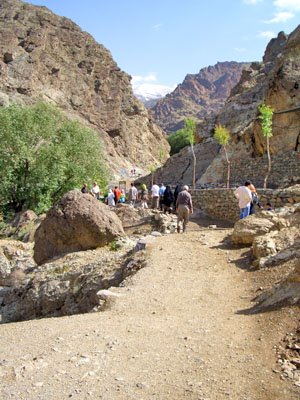
Summer turns Tehran into a white hot pit. And in much the same way as one places rocks around a fire, the mountains around the city seem to focus all the heat into the centre. Thankfully, they also provide sun-stricken city-dwellers with paths up to cooler climes. Deprived of altogether less wholesome entertainments, one of Tehran’s most popular weekend activities for all ages is “kuh raftan” – going to the mountains.

There are three main paths into the mountains in the north of the city where Tehranis flock at weekends.

TOCHAL

I used to go here a lot. It’s an easy walk from where I live and – smog allowing – you get amazing views of the city but that’s about all it’s got going for it as far as I’m concerned. In winter, skiers and snowboarders from Tehran’s wealthier communities drive up the broad path to the first station where they take the telecabin (cable car) to the high peaks. In summer though, the shadeless, dusty, flat track is hardly inviting during the daytime and who wants to go mountain climbing at night? Plenty of Iranians seem to, however, many stopping at the broad asphalt plateau at the first station to drink tea out of plastic cups and some at the surreally located paintball range which seems to have landed from another planet on the otherwise bare slope.

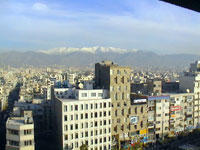
view of Tehran smog from Tochal

DARBAND

I’ve only been here once – and even then I didn’t go far up. From what I saw, this is easily the most commercially developed of the three. The narrow path that follows the cascading river is flanked on both sides with unbroken ranks of restaurants and coffee-houses, mostly quite large, with countless carpeted daises. Multicoloured fluorescent tubes and globes light up the white stucco crenellations of these establishments make the whole place look like a mountain-themed amusement park. Good place for a first date.

DARAKEH

By far the most appealing to nature lovers and the closest you’ll get to a genuine hike without leaving the city. The path starts in the narrow streets of an aged suburb shaded by tall plane trees and cut in two by a gushing stream that accompanies the walking path all the way up to near the peak. Unlike Tochal, the path never gets wide enough to allow more than four people to walk abreast and, for a city defined by indecorous driving, it’s refreshing to find that Tehranis are perfectly civil when faced with heavy pedestrian traffic.

The suburb of Darakeh
mountain path at Darakeh

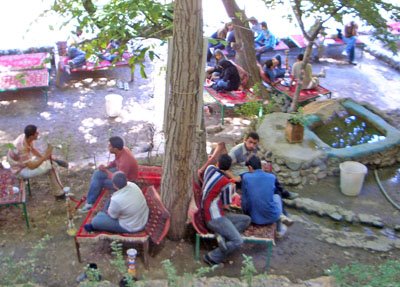
Pretty soon after leaving the last of the suburban residences behind, you can see families and groups of friends picnicking in shady spots by the wayside. Groups of schoolgirls maqne’eh tight, huddled around a secret. Lads lying out, using each other as pillows and passing the gheliyun. Some stop at the teahouses which stud the path until about two hours in, where old plane and walnut trees give their shade generously and you can order tea, dates and adasi (lentil soup).

Darakeh
Darakeh Coffee Shop (but everyone drinks tea)

The path is rocky and challenging enough in places to make the unaccustomed huff and puff. But that doesn’t deter a handful of specialist traders from making up a scattered, eclectic bazaar on the earlier sections of the mountain path. For instance, the dervish who sells organic cotton garments and imported Indian throws from his cliff perch, and the bookseller with his modern Persian classics and translations of Western philosophers. They and the kamancheh player who busks for change in front of the bookshop add their spiritual spice to the sunglasses and hat sellers and snack vendors.

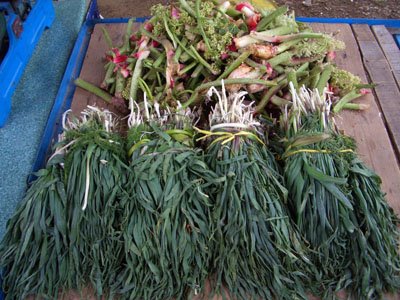
mountain herbs for sale

Having passed the stalls selling plump black cherries and pulpy mulberries we now see the orchards from which they came, the parasitic city now left far behind. Energetic teenagers try their height, jumping up at the branches which hang over the wire fence, their upper reaches still fully laden but the ground now covered with the stains of fallen fruit. We are now in productive lands. The crowds thin out slowly as you get higher but Iranians are quite prepared to carry full picnic sets including rugs, kettles, portable barbecues and gheliyuns in their tight-packed rucksacks quite a way up the mountain path. Once they’ve found the perfect spot by the riverbank, they may take the opportunity to pick the pungent wild herbs that grow there, cool their feet in the icy water or just savour the freshness of the air and the sound of the water, perhaps forgetting, just for a moment, exactly which city it is they’re from.

Darakeh Valley

Tehran Sightseeing Guide

Friday, August 12, 2005

Tehran

Guide to Tehran

Tehran
Tehran
Tehran or Teheran, the sprawling, chaotic, traffic-snarled, modern-day capital of Iran which still retains many sights from antiquity as well as many bustling bazaars and magnificent museums - including the Jewels Museum - which displays the last Shah's jewels and the Peacock Throne.

Tehran, Iran


Guide to Tehran

© Iranvisitor.com

Thursday, August 11, 2005

IranVisitor

A Journey to Iran

A journey to Iran - follow our blogs as we delve into the life and culture of contemporary early 21st century Tehran and the rest of the country.

A Journey to Iran

A Journey to Iran

A Journey to Iran

© Iranvisitor.com