Tourist & Resident Guide to Iran
Showing posts with label culture. Show all posts

Tuesday, August 23, 2011

London Iranian Film Festival

London Iranian Film Festival


The second London Iranian Film Festival takes place in November from 18-26th with other events and screenings happening throughout the summer.

London Iranian Film Festival


The Apollo Cinema on London's Regent Street and the French Institute's Cine Lumiere will screen some of the selected movies and there will be awards in four categories: feature film, documentary, short film and animation.

The Opera House in Holland Park showed the film The Song of Sparrows by Majid Majidi on August 22nd.

For further details see the website of ukiff.org.uk

Iranian Music

Books on Iran

Guide to Tehran

© Iranvisitor.com

Saturday, February 20, 2010

Books on Iran Slideshow

Books on Iran

See some recommended books on Iran, including books on Iranian history, culture, Tehran and travel.

Books on Iran


Iranian Music CDs Books on Iran Guide to Tehran

Saturday, March 28, 2009

The Remaking of Iran Exhibition

The Remaking of Iran Exhibition

Shah 'Abbas - The Remaking of Iran Exhibition is currently showing at the British Museum in London until June 14, 2009.

The Remaking of Iran Exhibition

The exhibition focuses on 17th century Iran during the reign of Shah 'Abbas I (1587–1629).

Long associated with his new capital city at Isfahan, the reign of Shah 'Abbas saw a period of peace and increased trade and prosperity.

The Remaking of Iran Exhibition

The objects on display, many seen outside Iran for the first time, include calligraphy, carpets, ceramics, Qur'ans, mosque lamps, paintings, and silks.

The British Museum also has a permanent collection of Persian art.

Iranian Music CDs

Guide to Tehran

© Iranvisitor.com

Monday, February 02, 2009

Hosein Kaffash

I

The street was already clear from yesterday’s snow though patches still reflected luminous white from the bare earth of the mountainside. The brushes, tins, knives and rubber heels in Hosein’s wooden cart rattled as its wheels stuttered over the gravel left behind from the salt trucks. A Peykan taxi trundled past in low gear, pulling its thick steel carcass up the hill without complaint like a passive mule. Snow had again not been forthcoming this year, the extended autumn was proving as dry and bright as the summer. Though his grandfather’s orchard in the north had been sold long ago, out of habit, Hosein wondered whether the mild winter would snap suddenly and decisively like the year before and throttle the unripe fruit of the orange trees.
Up ahead, a four-wheel drive attempted a handbrake turn but could only manage a disappointing two metre skid, grinding the gravel into the unrelenting asphalt with a scrape. The gleaming hulk sped away and Hosein could again hear the rattle which attended the wheels of his hand-built cart. He neared the corner where the street turned back on itself and climbed further up the mountainside. He stopped and felt a breeze, chilled by the snowy peaks above, waft down and touch the light sweat on his forehead. He closed his eyes, breathed, and frigid air stung a little on the inside of his sinuses. “Allah-e Shokr”, he whispered to himself, moved by the alternate sensations of heat from the pale winter sunlight and the ripples of cold in the air.
On the last Friday of every month, Hosein the Kaffash brought his work up to this pleasant part of town, perched high on the Tochal foothills, detached from the polluted inner-city air. The neighbourhood knew him well enough by now for many of the residents of the forty or so low-rise apartment buildings to keep any shoes in need of repair at home, anticipating his next visit, rather than carry them to Tajrish Square where two other cobblers plied their trade on the steps by the bank.
Hosein turned and saw that his son had fallen some way behind. “Ali-jaan, come to daddy, come on!” At his father’s call Ali broke into a staccato run. Thick layers of clothing under his puffer jacket made it difficult for his arms to swing and he held them out stiffly to his sides, the yellow woollen bobble on his winter hat bounced with each tiny stride. Now nearly seven years old, Ali was old enough to accompany his father on his Friday rounds, a convenience which gave father and son their only prolonged contact during the week and Mariam some respite at home, though for this Hosein sacrificed his day of rest.
Hosein the kaffash knelt down in front of his son from whose mouth steam-laden breath was pumping out in short gusts. His wide, pebble-black eyes blinked twice and opened to their widest and the boy smiled as Hosein pulled off his hat, dried off his hot brow with a gloved hand and ruffled his son’s matted hair.

Hosein Kaffash

II

Ali stood mutely observing a mean-looking black and white tomcat while his father climbed the steps of another of the three-storey blocks. The cat pleaded at regular intervals with a persistent howl issuing from the depths of unfulfilled hunger and lust. A middle-aged woman with no headscarf appeared at a second floor window to toss down a plastic bag of chicken bones. The bones half spilled onto the paving stones and the sound of the mesh screen sliding shut scratched the prevailing hush. Hosein rang the first floor buzzer and could hear the cat pawing at the plastic bag for a few seconds before the click of the intercom and a woman’s voice.
“Yes?”
“Good morning miss, I’m the kaffash. If you have any shoes to shine or repairs for me I’m at your service.”
“Oh, I see…. Let me ask my husband… Mehrdad!”
Another click and the intercom fell silent. Hosein rang the second and third floor buzzers but no answer came to disturb the greedy, hollow sound of the cat’s hard teeth on bare bones. Hosein shifted his cart into a bright triangle which the sun threw over the steps up to the entrance. From it he withdrew a tattered square of coarsely woven stuff cut from the thick material of a motorcycle saddlebag which he placed on the first step where he would sit. A man he recognised from previous visits emerged wearing a long overcoat over a casual t-shirt carrying a pair of black leather shoes in one hand.
“Salaam Agha, I’m sorry but it’s just these today. You repaired them the last time you were here, may your hands not hurt! If you could just shine them for me and leave them inside the front door when you finish.”
He handed the shoes down from his place on the landing and opened his wallet. He drew out a crisp two thousand toman note and both men’s eyes held the folded blue rectangle for a shared moment from opposite sides of a great divide.
“It has no value, I’m at your service.” Hosein offered his ta’arof, the ritual refusal to be payed, but the money was already in his hand. The shoes had lost little of the shine that Hosein himself had put on them a month before and with every stroke of his brush he fought off the sense that he was in league with the mendicant accordian players and street sweepers who rang the same doorbells for small change. His eyes narrowed on the smudged outline of his own face which was beginning to emerge on the shoe in his blackened hand.
The door of the next block opened and an amply-proportioned female form emerged, draped in a pale grey floral print chador. She edged sideways to plant her feet on the first step, directly opposite where Hosein was sitting, one hand holding the moulded concrete bannister and the other cradling a tray against her bosom.
“Ali, go and help the lady. Quick!”
Without a word, the boy ran to the bottom of the steps, slipping and saving himself from a fall with both his hands. He beat his gloves free of the still fresh snow.
“Careful now, Ali.” Hosein observed the handover with as much care as the woman and young Ali executed it. “May your hands not hurt, you’ve made so much effort, thank you ma’am. Say thank you Ali,” to which Ali responded with a straightforward, “merci.”
“Oh, it’s nothing, I’m so ashamed,” the woman replied with a self-deprecating chuckle. She had a round face and a turned up nose. With her arms concealed under her grey chador she looked comically like an owl. “I’ll ask my grandson if he has any work for you,” she said.
Calling on Imam Ali for strength, the old woman hauled herself back up the steps with the same determined effort with which she had descended. Hosein rested the tray on his wooden cart and as father and son shared the unfamiliar tasting food, the relentless mewing of the vagrant black and white cat began once again. Hosein tossed him a scrap which did nothing to silence him.

© William Yong, 2009

Friday, January 09, 2009

Short Cuts: Ta'arof

Short Cuts: Ta'arof

The two men ordered their kebabs and the waiter motioned for them to sit at a simple formica table. The tiny kebab restaurant was busy this evening on the eve of Eid-e Ghadir.

Outside the first snow of the year was falling gently on the glossy black streets. One of the men adjusted the position of a steel frame chair and sat. It was a tactical slip which allowed his friend to open the play in a classic ta’arof gambit.

Short Cuts: Ta'arof

“Right, so why don’t I go next door and get us some fresh juice, what’ll you have?”

Taken by surprise, the seated man had no option but to come back at his friend with a rather cliched rejoinder, “thank you sir, but please be my guest.” His predictably vain attempt to get up and beat his opponent to the door was stopped by his friend’s outstretched arm.

“Come now, I won’t hear of it, let me this time, melon? pomegranate? These are on me,” the standing man said as he turned and made for the exit. Perhaps his move for the door was a fraction of a second premature.

“Ok, ok,” the seated man replied, seeing that the only way to keep his chances alive now was to feign surrender and come back with a different approach, “I’ll come with you, I can’t decide what I want until I see what they have.”

The two exited the restaurant together. Both men fingering their wallets.

(c) William Yong

Thursday, October 23, 2008

Thursday Night at the Bakery

Thursday Night at the Bakery

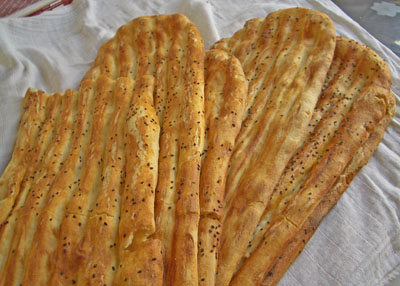
I'm sitting on the step in the last of the evening light, waiting in a queue of around five. It’s mostly men in the evenings, wives will be at home preparing dinner. It’s also the first day of the weekend, so tonight, demand for fresh “naan sangak” - a wholesome flat bread cooked on hot pebbles - is high.

barbari bread

Little brother scoots past my knees carrying a bundle of separated newspaper pages, ready for customers to grab to wrap their hot bread. The family business starts from the littlest one up on this Thursday evening shift. Inside, a boy not much older retrieves the cooked bread on a spatula as it appears on the revolving stone plate which carries them through the oven. The lad’s stout frame suggests he’s the older brother of the chubby little newspaper boy. His advantage in years puts him one step closer to the production end of the family business.

At peak times you won’t find a single Tehran bakery without waiting customers spilling into the street outside. Mass-produced bread is available at supermarkets but the reaction at home when you bring back a still-warm armful from the local bakers’ speaks of a link between man and his staple food that plastic packaging somehow comes between.

There’s a dull clang of wood on metal as the twenty-year-old baker’s apprentice drops the long palette handle into its holder. Even before it stops rattling his hands are in the aluminium trough to grab another slick, wet pat of dough. He’s the hard-running fly-half of the operation, the living link between the raw stuff and the furnace. If he wants to run his own bakery one day he’s got to serve his time at the oven door.

While the midfield dynamo continues to hum, the master baker’s assured eyes are on the doorway, watching the fading light of the evening. He’s transferring the last of the dough from the big aluminium mixer to the trough for the apprentice to work with. Pulling out a larger lump of the gloopy raw stuff than I think two hands can handle, I worry that the dough which is lolling over and around his wrists, is going to fall onto the floor. But his hands know the consistency of the stuff of his trade better than that. They guide the lump into the half-empty trough and it falls in with a slap.

The lanky understudy with his Roman nose watches as the master baker gives his last orders and departs. I imagine the young man's thoughts are on the possibilities of the weekend as he continues to eye the doorway with his hands in the dough.

“How many do you want?” the apprentice asks a youth standing in line.

“Seven,” the boy answers. He’s no more than a teenager but the stains on his clothes, tanned neck and arms and world-weary expression suggest he’s already spent more than a little time working to pay his keep. Perhaps he’s one of the hundreds of young men who dig around in trash cans to collect recyclable materials for cash.

“You can have seven ‘nun-e salavati,’” the apprentice motions to the pile of bread kept aside for those who don’t have the money to pay.

“No,” the boy answers stoically.

“Take them, they’re fresh,” the apprentice insists. According to Iran’s tradition of ta'arof a genuine offer is never made only once.

But with an upward nod of the head which Iranians employ to express an outright objection, the pauper boy insists the issue is closed. He turns his back and rejoins the rest of the customers waiting in line.

Iranian Music CDs

Guide to Tehran

Azari teahouse

© Iranvisitor.com

Friday, August 22, 2008

Iran Collection British Museum

Iran Collection British Museum

The British Museum in London has some of the finest pieces of ancient Persian art outside of the National Museum in Tehran.

Iran Collection British Museum

Many of the pieces were excavated by Robert Gordon from Persepolis in the early 19th century.

Iran Collection British Museum.

The citadel of Persepolis was constructed by Darius I around 500 BCE and the iconography of the sculpures and relief works included influences from Egypt, Greece and Mesopotamia. Persepolis was destroyed by the Macedonian invader Alexander in 330 BCE.

Iran Collection British Museum

British Museum

Guide to Tehran

© Iranvisitor.com

Wednesday, March 26, 2008

National Museum of Iran Tehran

National Museum of Iran Tehran


The National Museum of Iran in central Tehran is not to be missed on any visit to the capital.

National Museum of Iran, Tehran

The original building of the museum, which houses the pre-Islamic exhibits dates from the 1930s and was designed by French architect, Andre Godard.

Building 1 of the museum houses artifacts ranging from Iran's prehistoric past to the Elamite, Achaemenid and Parthian periods.

Image © Camille-Helene Lemouchoux & IranVisitor.com

© Iranvisitor.com

Thursday, June 07, 2007

"Eeenja Iran-e!" (This is Iran!)

"Eeenja Iran-e!" (This is Iran!)

This is an excuse I hear a lot when things are not the way they should be. It's usually employed once a solution to a problem is identified and thoughts turn to putting it into practice.

This is Iran!

"But this is Iran!" It's not as easy as that! Sure, that's the problem and this is the best way to get around it but this is Iran. Don't expect things to go so well....

[ followed by any/all of Iran's 3 great national excuses.]

1. First of all people 'don't have culture' here [the Farsi word for this is 'bifarhang' which has no direct translation] they don't know how to behave. You tell them one thing and they do another. They're uneducated and they don't know how to follow rules....

2. And the government doesn't let people get on with their lives. One day one politician launches a policy, the next day he's gone and his replacement wants something else. He gives government jobs to all his cronies and they start filling their pockets and before they've had enough so they can really start work their boss gets the sack and another politician/set of cronies starts all over again!

3. Do you expect the West would let us improve? We were developing a perfectly good democracy until the US stepped in and took away the only decent leader we'd had since Abbas the Great [meaning Mohammad Mossadegh]. And the British are twice as cunning.... Everyone knows George Bush is in Tony Blair's pocket. The mullahs all take their orders from England. It's been like that for centuries and don't think it's going to change soon!

Guide to Tehran

© Iranvisitor.com

Saturday, October 01, 2005

Blood On The Tracks in Tehran

Blood On The Tracks

Slaughtering a sheep
To mark the purchase of a new Toyota Camry, this poor creature had its blood spilled in a private car park in Qazvin.

Having slit its throat with practiced ease the slaughterer dipped his hands in the blood and daubed all four of the car’s tyres while uttering blessings.

However gruesome this may seem, the death of this lamb was not in vain.

Meat from the animal was to be given to the local poor as part of the celebrations for the birthday of the 12th Shiite Imam – the Imam Mahdi, set to return to the world when he is most needed.

© Iranvisitor.com

Wednesday, August 31, 2005

Iran UNESCO World Heritage Sites

Iran UNESCO World Heritage Sites


Here is a list of UNESCO World Heritage sites and the year they were inscribed to the list.

Esfahan


Tchogha Zanbil (1979)
Meidan Emam, Esfahan (1979)
Persepolis (1979)
Takht-e Soleyman (2003)
Bam and its Cultural Landscape (2004)
Pasargadae (2004)
Soltaniyeh - the mausoleum of Oljaytu (2005)

Iran UNESCO World Heritage Sites

Tehran


Guide To Iran and Iranian Culture

© Iranvisitor.com