Books on Iran
See some recommended books on Iran, including books on Iranian history, culture, Tehran and travel.

Iranian Music CDs Books on Iran Guide to Tehran

See some recommended books on Iran, including books on Iranian history, culture, Tehran and travel.
By Ryszard Kapuściński
Mohammad Reza Pahlavi, the last Shah of Iran, embarks on an ill-considered push towards modernization, fuelled by oil wealth and driven by a greed for admiration. Kapuściński recalls photographs, using them as cross-sections of history’s great worm through time. Here, Reza Pahlavi, the Shah father, is pictured with his young son. They wear identical uniforms. The symbolism is powerful and entirely intended.

Iran too has its own psyche and hang-ups. The unconscious rural poor are irreconcilable with the Pahlavi ego, keen to strive forward. And the rebellious streak in Shiism means that Iranians are never sad to see their Shahs’ heads fall. One of the most delightful moments in this book is when the author conjures up the first Shiites’ teaching Iranians that “you can be a Muslim without being an establishment Muslim… you can be an opposition Muslim! And that makes you an even better Muslim!” “Shiism”, he later defines is “a form of national survival” but he does not face head-on the brooding spectre of Ayatollah Khomeini in his reckonings. The rise of the Islamic Republic only proves that “it is not always the best of men who emerge from hiding.”
In one of the longest sections of the book, Kapuściński turns novelist and tells of the first tentative words of opposition in the fashion of a Dostoevsky, but instead of a murderer as a subject/protagonist, he follows a returned émigré intellectual who witnesses the beginnings of unrest but remains in denial, running in fear from SAVAK. Then from the novel to the theatre. Kapuściński goes on to portray the Shah as an incompetent director using vast amounts of “imported scenery” for his play, “The Great Civilisation” – an absurdist piece in which, against his wishes, the extras tear down the stage at the end.
A veteran of political unrest (by his own count, Iran was his 27th revolution) journalist Ryszard Kapuściński leads us on an impressionistic journey through the roots in history and psychology of the players right up to the tipping point “when the policeman shouts but the man doesn’t run.” His observations weave the mundane with the profound to achieve drama, involvement and even comedy. Clearly appreciating the Python-esque surrealism, he includes, from an Iranian newspaper, an interview with a professional “wrecker of the Shah’s monuments” who unwittingly tells the story of the last Pahlavi monarch through that of his own travails with rope and hook.
“––Does that mean you would pull down, he would set up, then you would pull down what he set up, and it kept going like this?
––That’s right. Many times we nearly threw in the towel. If we pulled one down, he set up three.”
Will Yong
Buy Shah of Shahs by Ryszard Kapuściński from Amazon
UK
Japan
By Steve Kinzer

Iran's recent development of uranium enrichment facilities has been referred to in the official national media as an event even more significant than the nationalisation of the oil industry in 1951. But while borrowing the historical imagery of Iran's first great victory against imperialism, nothing is said by the country's leaders of the man who led the charge, Mohammad Mossadeq.
"All The Shah's Men" is a pulsating account of the rise of this champion of Iranian nationalism, his nationalisation of the oil industry and his subsequent downfall at the hands of the CIA in 1953 that shows just how big a part US foreign policy played in the creation of a "rogue state". This book is essential reading for understanding the combination of reverence and injustice that many Iranians still feel having been robbed of their great nationalist hero, and why Iran's current regime now has no place for him in their own national mythology.
Kinzer paints a sympathetic picture of this man who coughed blood seemingly as a direct consequence of the injustices that the British were being allowed to perpetrate in his country through the Anglo-Persian Oil Company (later, the Anglo-Iranian Oil Company and later still, British Petroleum). For a people raised on the idea of personal martyrdom, the fainting fits, coughing blood and involuntary tears of this highly emotional character all added to his popular appeal.
Since oil had been discovered in Iran by British engineers in 1908, the Anglo-Persian Oil Company (later, the Anglo-Iranian Oil Company and later still, British Petroleum), had become one of the key elements of the Empire. Safeguarding oil supplies ran parallel with protecting the entire imperial ideology whose foundations in monopolising the riches of other countries had already begun to look tenuous. Thus, to arch-imperialists such as Churchill and Eden, Mossadeq was a man who might have brought down an empire.
Across the Atlantic, two radically different ideologies were doing battle over how best to approach the threat of Communism. While Truman had thought it best to ride the wave of nationalist movements and help them to stand independently against the red tide, the incoming Eisenhower administration preferred a more "hands-on" approach. The British knew that the fear of Communism could drive the incoming president to extreme action and it was their encouragement that paved the way for the birth of the regime change rationale that was to characterise much of US foreign policy in the decades that followed.
Complete with its swashbuckling anti-hero, CIA agent, Kermit Roosevelt, at the helm of anti-Mossadeq operations on the ground, Kinzer's book reads more like a spy thriller with political punch than it does a straightforward history. And it is indeed the good-natured ease with which he approached his job that highlights just how callous an approach to world politics his masters in Washington were taking. Covert action seemed, at the time, to be a satisfyingly direct and cost-effective device to ensure a more favourable regional situation, it is clear that with the Islamic world currently rising up in anger against US heavy-handedness, the real price of the coup is clearly still being paid.
Following the story of this national hero to its conclusion in the Mossadeq family estate where he spent his final years under house arrest, Kinzer gives touching accounts of the quiet memories that still echo around the village to which he was kind patron and generous benefactor. There is no escaping the question of what might have been if he had been allowed to lead the whole of Iran. What could have been if the British hadn't been so intransigent, if the Truman doctrine had not given way to Eisenhower. If a national hero had been allowed to rule the country that had wanted him, that needed him and who had elected him.
Buy All The Shah's Men by Steve Kinzer from Amazon
USA
UK
Japan

Iran is the world's fourth-largest producer of crude oil. In 2002 Iran produced approximately 3.72 million barrels per day (Mbbl/d). It is estimated that Iran has the second-largest reserves of untapped petroleum in the world, (125.8 billion barrels) second only behind Saudi Arabia (260 billion barrels). Iranian reserves amount to one-tenth of the world's estimated total supply. Iran also has estimated reserves of 940 trillion cubic feet of gas about 16% of total world reserves.
Petroleum production has been the main industry in Iran since the 1920s. The oil industry was nationalized in 1951 with the then government forming the National Iranian Oil Company (NIOC). Petrochemical exports now generate about US$1 billion dollars a year with major trading partners being China, India and Japan. In 2003, the vast majority (about 90%) of oil exported from the Persian Gulf was carried by tanker through the Strait of Hormuz.
In 2003, Iran announced the discovery of the world's second largest oilfield near the Persian Gulf port of Bushehr with an estimated reserve of 38 billion barrels.
Blood and Oil: The Dangers and Consequences of America's Growing Dependency on Imported Petroleum by Michael T Klare

By Arthur Upham Pope
With the history of Persia as long as the history of mankind itself, it is no surprise that its architectural legacy should be one of the richest in the world.
It is perhaps only the relative inaccessibility of Iran's architectural treasures in recent years that has caused Persian architecture to be less well regarded in comparison with that of other great civilisations. However, what is clear from the rich yet concise tour offered by Arthur Pope's "Introducing Persian Architecture", is that Persian architecture can be compared to that of Ancient Greece and Egypt without any hint of inferiority.From the ziggurat of Chogha Zambil, through to the noble ruins of the pre-Islamic Persian Empire and all the way up to the mosques and palaces of Isfahan and Shiraz, Pope cuts a great sweep through 3,000 years of history without losing his focus on the finer points of construction and ornamentation that made up his life's work.
It is in itself an achievement for such a learned and passionate scholar to condense his knowledge in a volume so well-organised and accessible for the newcomer. Numerous plates, including full colour photographs and architectural plans are conveniently cross-referenced with the text throughout the book.
Now more than 35 years old, "Introducing Persian Architecture" remains one of the best companions one could possibly have on an architectural tour of Iran. For even a short visit to Isfahan and Shiraz the cost and effort of obtaining a copy would be repaid many times over. Having picked an almost mint copy of the 1976 edition in a dusty Tehran bookshop for next to nothing, it seems likely that second-hand copies are widely available.
Introducing Persian Architecture
By Arthur Upham Pope
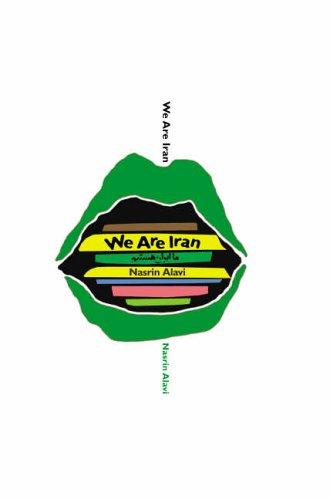 We Are Iran
By Amir Taheri
Part biography and part political history, Amir Taheri’s “The Spirit of Allah” (a direct translation of Khomeini’s given name, “Ruhollah”) is at once a detailed examination of the revolution in Iran and a three-dimensional portrait of the man whose almost gravitational centrality to it made him one of the most important and controversial figures of the late twentieth century. Beginning with his ancestry and birth and continuing to within months of his death in 1989, the book documents Khomeini’s early struggles to establish himself as a religious teacher and his life in exile and growing influence over Iranian politics from abroad, culminating with his return to Iran and the first troubled years of the Islamic Republic.

Insights into the early life and private world of the self-proclaimed Imam paint a three-dimensional picture of a religious leader who himself saw little more than black and white. Apart from a sensitivity to poetry, two of his own works being reprinted as an appendix, the bleakness of the Ayatollah’s personal life, and the volcanic anger he directed against a world he saw as corrupted fed his single-minded ambition to oust the Shah. His intolerance of politicians and ignorance of economics were to be great strengths in justifying his uncompromising pursuit of this goal.
For Khomeini, the establishment of the Kingdom of God on Earth was to be the aim and the responsibility of the sanctified institution of the Mullahs, in particular, those who, like him, could claim a direct line of descent from the Prophet Mohammed himself. Obedience to the law of Islam, as interpreted by his pessimistic pietism, was to be imposed from above since it was essential that the spark of the Devil, which he believed to reside in all men, be tamed. We find in Khomeini one who was not power-hungry but yet refused to allow the momentum of the multifaceted revolutionary movement to be directed by any ideology other than the radical morality that he advocated. This grim, single-minded determination was to justify acts ranging from the telling of knowing half-truths to divert his enemies to the execution of young girls.
As the emphasis of the work moves from personal history to the momentous events of the mid-1970s, Taheri documents the social, political, and economic factors that were undermining the Shah’s hold on power while never losing sight of the pivotal importance of Khomeini himself. Taheri, a newspaper editor, and journalist has brought together innumerable sources including speeches and documents written by Khomeini himself and numerous newspaper articles, eyewitness accounts and personal interviews to add minute detail and depth to a story which, twenty-five years on, is rapidly being distorted by discontent within Iran and ideology outside it.

