Bridal SUV in Tehran, Iran

Iranian weddings are floral feasts and the car that gets the bride and groom to the ceremony is always elaborately festooned.
Travel Guide to Tehran
Travel Guide to Esfahan
© Iranvisitor.com

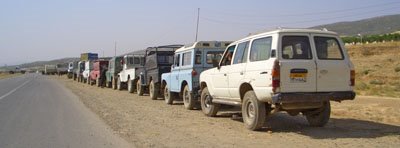
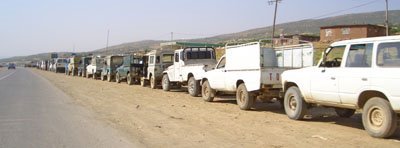

The twelve-pump state-owned filling station in Tehran’s Velenjak suburb had never seen a queue like this. Though constantly and doggedly jammed with an irreconcilable jumble of aging Paykan taxis, family-owned Kia Prides and sleek German status-mobiles, there is never more than a 20-minute wait.
But here in Naghadeh, West Azerbaijan, it was nearly a kilometre before any indication of the petrol station could be seen above the roofs of the jeeps and pickups that filed motionless down the dusty highway. There was, however, no sign of unrest. The drivers, resigned to spending the day here, either slept or chatted and shared tea and melons in the shade.
The complete absence of regular city cars at this local filling station told the whole story. Naghadeh, situated southwest of salt-infused Lake Urumieh, is a prime filling point for gasoline smugglers. The nearby border with Iraq has become porous since US forces handed control over to Iraq's own forces four months ago. All of these sturdy, hard-working vehicles will take their full tanks west into Iraq and then finally to Turkey where petrol prices are ten to fifteen times more expensive than at Iranian pumps.
No greater irony can exist in oil-rich Iran than a shortage of petrol. Iran consumes 70 million litres of petrol per day while its refineries produce only 40 million – making Iran a net importer of petrol despite having the world’s third largest oil reserves.
The causes are well-known and endemic. Government subsidies keep pump prices down to as low as 800 Rials ($0.09) per litre which encourages wasteful consumption and provides an incentive for smugglers.
Government plans to curb this problem through rationing have been shelved due to the absence of a framework to track consumption and the general public’s heavy over-reliance on private cars and taxis. Indeed it is hard to imagine car-clogged Tehran taking rationing or a hike in petrol prices lying down.
Shortages, intolerable waits and empty pumps have motivated Naghadeh residents to pre-empt the national government in taking action. They have forced local lawmakers to accept a rationing system of their own design. Computer systems which track the registration numbers of vehicles coming to local pumps have been supplied and programmed entirely at the expense of private citizens. Motorists are now limited to one full tank every three days. Since most smugglers try to make one trip per day, this measure is set to cut queues significantly.
Nevertheless, this local measure is unlikely to be a precursor to any national efforts. While oil revenues continue to be buoyed by soaring prices, Iran will not be forced to take any painful measures to ease its dependence on imported petrol. For the meantime at least, it can afford to feed its unhealthy addiction by providing the rest of the world with the raw materials to feed their own.

With car pools now being hailed as the answer to urban traffic problems the world over some credit must be given to Iran's already long-established system of taxi-sharing.
The key difference between a private cab and a shared taxi is that complete strangers who happen to be going the same way will jump in with you. Drivers position themselves at bus stops and other major junctions and either call out a destination of their own choosing or be open to suggestions from a largely fixed set of popular nearby locations. Some travelers simply choose a strategic point on a main road and call out to passing cars – chances are one or more of them will be a shared cab.
It might be that you have to take more than one shared cab and walk a little to reach your destination but, at a fraction of the cost of a private cab, the shared taxi is a cost effective and efficient mode of transport between Tehran's major centres and a lesson waiting to be learned by the West.


