Tourist & Resident Guide to Iran

Tuesday, April 04, 2006

Noruz Table

Noruz Table


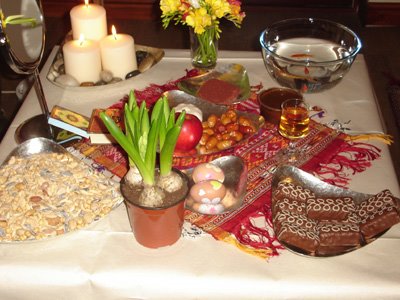
A traditional Noruz table (Sofreh haft-seen) consists of seven kinds of food, each beginning with the letter S or sin in Farsi, which represent the virtues of abundance, health, life, love, patience, purity and wealth.

Noruz table

Sabzeh - wheat or lentil sprouts symbolizing rebirth.
Samanu - a creamy wheat germ pudding with sacred connotations.
Seeb - apples represent beauty and good health.
Senjid - dried fruit of the lotus tree symbolizing love.
Serkeh - vinegar represents longevity and the virtue of patience.
Sir - garlic symbolizes good health due to its medicinal properties.
Somagh - sumac berries symbolize the brightness of the sun and the ultimate victory of good over evil.

Noruz table

Flowers such as hyacinths Sonbol and tulips Laleh can also be placed on the Noruz table and represent Spring.
Painted eggs are symbols of fertility.
The mirror represents the life reflected, candles reveal happiness and goldfish symbolize life and energy.

Images kindly provided by Mohammed, an Iranian Msc student at Metropolitan University, London

Iranian food

© Iranvisitor.com

Wednesday, March 29, 2006

Skiing in Iran

Skiing in Iran


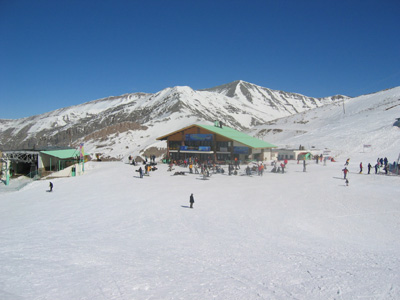
There are a number of excellent skiing resorts in Iran, mostly in the Alborz mountains to the north of the capital, Tehran, though there is also piste near Kermanshah and Tabriz.

Ski Resort, Alborz Mountains

The sport was introduced to Iran in the 1930s by German railway workers and often taken up by returning Iranian expats from Europe. In 1947 the Iranian Ski Federation came into existence. Iranian skiers now regularly compete at the winter Olympics.

Skiing was initially prohibited after the 1979 Revolution but was allowed again in 1988. Costs are minimal if you have the equipment (though everything can be hired at the resorts) and the season in the Alborz mountains lasts from November to the end of March.

Mount Damavand, Alborz Mountains

The slopes nearest to Tehran will be packed now at Dizin, Tochal, and Shemshak for Noruz.

Iranian Ski Federation

© Iranvisitor.com

Monday, March 20, 2006

Iranian Embassy in London

Iranian Embassy in London

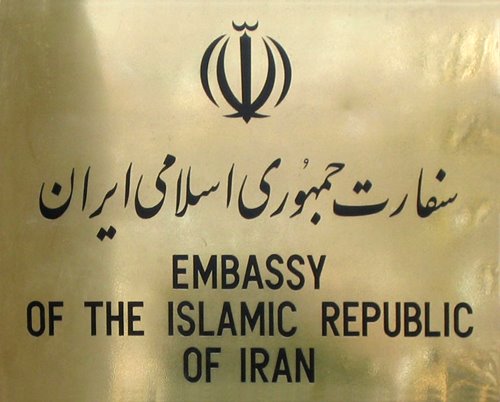
Iranian Embassy

Iranian Embassy in the United Kingdom
16 Prince's Gate
London SW7 1PT

The nearest underground station to the embassy which overlooks Hyde Park is Knightsbridge on the Piccadilly Line.

Iranian Embassy

© Iranvisitor.com

Thursday, February 16, 2006

Saturday, February 11, 2006

Islamic Revolution Day

Islamic Revolution Day


Today, February 11 is the 27th Anniversary of the Islamic Revolution in Iran when Ayatollah Khomeini came to power in 1979 and is celebrated as a national holiday.
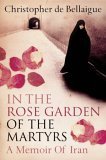
In The Rose Garden of the Martyrs - Buy this book from Amazon

Other national holidays in Iran are:

Oil Nationalization Day - March 20
This day celebrates the nationalization of the Anglo-Iranian Oil Company in 1951.

Noruz - around March 21-24
Iranian New Year "Noruz" (lit. new day) is celebrated on the Spring Equinox and many Iranian return to their home towns during this period.

Islamic Republic Day - April 1
The anniversary of the beginning of the Islamic Republic.

Sizdah Bedar - April 2
This is the 13th day of the Persian new year when many Iranians leave their homes and go on picnics to avoid bad luck.

Heart-Rending Departure of the Great Leader - June 4
The anniversary of the death of Ayatollah Khomeini in 1989.

Anniversary of the Arrest of Ayatollah Khomeini - June 5
The anniversary of the arrest of Ayatollah Khomeini in 1963, when he urged Muslims to revolt against the superpowers.

Anniversary of the Death of Dr. Seyed Behesthi - June 28
The anniversary of the death of Dr. Seyed Behesthi, a key Khomeini ally in 1981. Behesthi was killed by a bomb blast, along with 72 other people, at a meeting of the Islamic Republic party.

Day of the Martyrs of the Revolution - September 8
The anniversary of the deaths of several hundred people killed when Iranian troops fired on a Tehran demonstration against the Shah in 1978.

Religious Holidays

Iran also has many religious holidays which are celebrated on dates according to the Muslim lunar calendar.

In The Rose Garden of the Martyrs - Buy this book from Amazon
USA
UK
Japan

© Iranvisitor.com

Saturday, February 04, 2006

Iran's Oil Industry Blood & Oil

Iran's Oil Industry

Blood & Oil

Iran is the world's fourth-largest producer of crude oil. In 2002 Iran produced approximately 3.72 million barrels per day (Mbbl/d). It is estimated that Iran has the second-largest reserves of untapped petroleum in the world, (125.8 billion barrels) second only behind Saudi Arabia (260 billion barrels). Iranian reserves amount to one-tenth of the world's estimated total supply. Iran also has estimated reserves of 940 trillion cubic feet of gas about 16% of total world reserves.

Petroleum production has been the main industry in Iran since the 1920s. The oil industry was nationalized in 1951 with the then government forming the National Iranian Oil Company (NIOC). Petrochemical exports now generate about US$1 billion dollars a year with major trading partners being China, India and Japan. In 2003, the vast majority (about 90%) of oil exported from the Persian Gulf was carried by tanker through the Strait of Hormuz.

In 2003, Iran announced the discovery of the world's second largest oilfield near the Persian Gulf port of Bushehr with an estimated reserve of 38 billion barrels.

Guide to Tehran

Blood and Oil: The Dangers and Consequences of America's Growing Dependency on Imported Petroleum by Michael T Klare

Buy this book from Amazon
UK
Japan

© Iranvisitor.com

Wednesday, January 11, 2006

Images: Tehran by Neville Powis

Images: Tehran


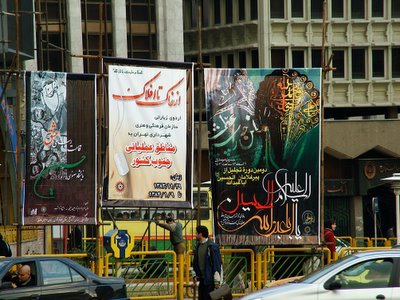
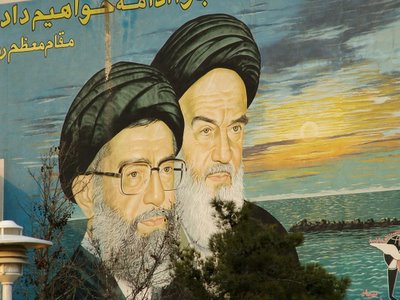
Photographs of Tehran in 2005 by freelance cameraman and filmmaker Neville Powis.

-Click on the image to see the larger version.


Tehran (c)Neville Powis
All Rights Reserved Neville Powis

Tehran (c)Neville Powis
All Rights Reserved Neville Powis
© Iranvisitor.com

Sunday, December 04, 2005

Images: American Car Relics in Tehran

Images: American Relics

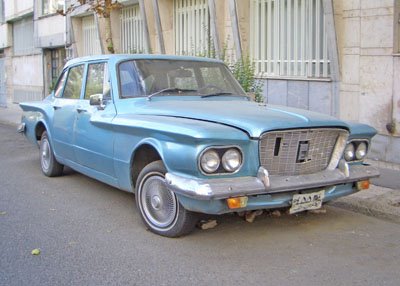
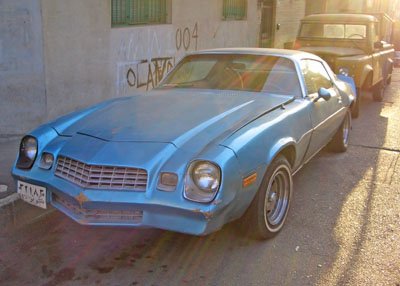
The streets of Tehran are home to a veritable museum of old American cars, though, admittedly, they are often not the best-preserved specimens.

Affectionately referred to by Tehranis as “boats” these gas-guzzling monsters are currently the target of a government trade-in scheme which helps their owners buy new cars more cheaply.

american relic

american relic

american relic

Cars in Tehran

Gasoline Smuggling

© Iranvisitor.com

Iran Price Check

Random prices from life in Tehran

Iran Price Check


Sangak bread (30cmx80cm) - IR1500 ($0.17)

30 minute ride in a private taxi – IR25,000 ($2.75)

15 minute ride in a shared taxi – IR2500 ($0.28)

Bus ticket – IR200 ($0.02)

1 litre of petrol - IR800 ($0.09)

Monthly natural gas bill for a block of 8 apartments – IR150,000 ($16.50)

Espresso coffee in a continental style café – IR20,000 ($2.20)

Hourly rate of pay for an English teacher in a private language institute – IR25,000 ($2.75)

Guide to Tehran

Tea in Iran

Tea in Iran

Before she says her morning prayers, it’s time for Mahin Khanom to turn on the samovar. With gas this cheap (practically free) this stove-top kettle is going to be bubbling away for almost the whole day, constantly at the ready to dispense hot water for that all-important cup of black tea.

In Iran tea is taken straight. Sugar is sometimes added by those who like a sweet kick in the mornings but milk, never. It is the ever-present accompaniment to, well, everything. In the company of guests, multiple glasses will be drunk both before and after dinner. On a break from work, one or two glasses with a couple of sugar lumps melting in the mouth give English teachers the buzz to get them through their next lesson.

In the morning with breakfast, of course. If you’ve caught a cold, it’s important to consume an almost constant stream of weak tea. Even while on the move, it is not unusual for taxi or bus drivers to have a cup in one hand and the wheel in the other. Thankfully, Tehran’s numerous motorcyclists haven’t yet worked out how to sup and drive.

Tea in Iran

This is a traditional brass samovar. It hasn’t been used for years. These days, stainless-steel stove-top and electric versions are far more common. 

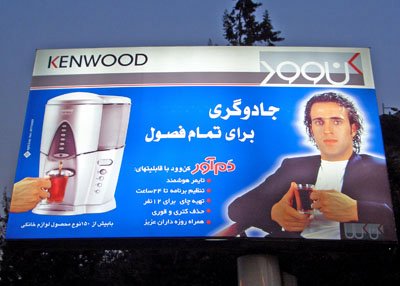
Household appliance makers such as Tefal and Delonghi are also in on the act with modern versions in sparkling white/chrome which you can see on advertising boards all over the city.

(Bayern Munich midfielder Ali Karimi can currently be seen on billboards gormlessly drinking tea for Kenwood.)
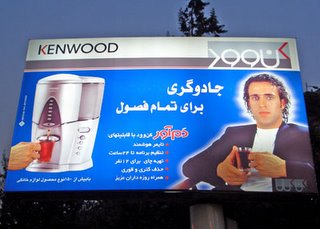
Ali Karimi drinking tea
Tea in Iran

Iran Tea Facts

• Iran consumes approximately 100 million kg of tea, of which 50 million kg is imported.

• According to the Iran Daily, Iranian grown tea contains less caffeine and Iranian growers use less chemical pesticides due to more favourable weather conditions than in countries such as India and Sri Lanka.

• Despite their political differences, the USA has granted a quality certificate to Iranian tea to allow it to be imported. Britain, which owns the world’s largest tea factories, also imports Iranian tea, repackages it, and resells it.

• Due to an enduring attachment to British-made products, one of Iran's biggest-selling tea brands is Ahmad Tea of London.

Azari teahouse

Iranian food

© Iranvisitor.com

Thursday, November 03, 2005

Book: Introducing Persian Architecture

Introducing Persian Architecture

Introducing Persian Architecture.

By Arthur Upham Pope

With the history of Persia as long as the history of mankind itself, it is no surprise that its architectural legacy should be one of the richest in the world.
It is perhaps only the relative inaccessibility of Iran's architectural treasures in recent years that has caused Persian architecture to be less well regarded in comparison with that of other great civilisations. However, what is clear from the rich yet concise tour offered by Arthur Pope's "Introducing Persian Architecture", is that Persian architecture can be compared to that of Ancient Greece and Egypt without any hint of inferiority.From the ziggurat of Chogha Zambil, through to the noble ruins of the pre-Islamic Persian Empire and all the way up to the mosques and palaces of Isfahan and Shiraz, Pope cuts a great sweep through 3,000 years of history without losing his focus on the finer points of construction and ornamentation that made up his life's work.
It is in itself an achievement for such a learned and passionate scholar to condense his knowledge in a volume so well-organised and accessible for the newcomer. Numerous plates, including full colour photographs and architectural plans are conveniently cross-referenced with the text throughout the book.
Now more than 35 years old, "Introducing Persian Architecture" remains one of the best companions one could possibly have on an architectural tour of Iran. For even a short visit to Isfahan and Shiraz the cost and effort of obtaining a copy would be repaid many times over. Having picked an almost mint copy of the 1976 edition in a dusty Tehran bookshop for next to nothing, it seems likely that second-hand copies are widely available.

Introducing Persian Architecture

By Arthur Upham Pope

Buy this book from Amazon
UK
Japan

© Iranvisitor.com
Sunday, October 30, 2005

Drug Use In Tehran

Drug Use In Tehran

Drug Use In Tehran.

by Francis Moraes PhD

Research on Drug Use conducted by AHRN (Asian Harm Reduction Network) from People Using Drugs (PUD) in Iran

* Heroin and opium are the main drugs in Tehran

* Among questioned PUD, Opium in Tehran (n=175) is generally smoked (75%), while 37% have eaten it and 6% mention injecting

* In Tehran, more than 50% of PUD mention opium-based drugs as their drug of initiation

* In Tehran, opiate use (largely heroin and opium) is extremely common among PUD and 71% of the opiate users started their drug career with an opiate. About two thirds are PID (People Injecting Drugs) and almost a quarter of them initiated through injecting (heroin).<

Courtesy of and thanks to AHRN (Asian Harm Reduction Network) for permission to publish this research.

Buy this book from Amazon
USA
UK
Japan

Guide To Iran - IranVisitor

Guide to Tehran

© IranVisitor.com

Wednesday, October 26, 2005

We Are Iran

We Are IranWe Are Iran
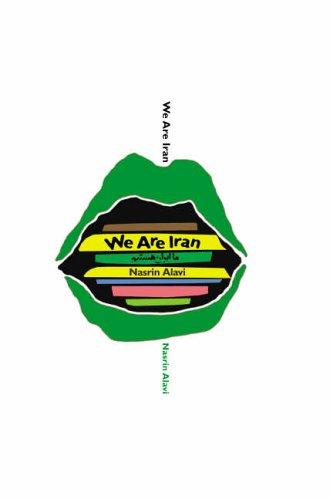
by Nasrin Alavi

Portobello Books Ltd, 336 pp

This new book (published in 2005) by Iran-born and British-educated Nasrin Alavi (a pseudonym), and translated from the original Farsi, presents the views and musings of Iran's estimated 60,000 plus web bloggers. Topics range from the private thoughts of women behind the veil, the media, music and dancing, romance and living with the religious authorities. Blogs have exploded in Iran since 2001 when Hossein Derakhshan, a young Iranian journalist, created what was then Iran's first blog.

Buy this book from Amazon
UK
Japan

Some Featured Blogs

golku.blogspot.com
baakereh.blogspot.com
malakut.org

Reviews

Tehran Sightseeing Guide

Iran Book Reviews

Tuesday, October 25, 2005

Child's Dress Vakil Bazaar Shiraz

Child's Dress Vakil Bazaar Shiraz


Child's Dress, Vakil Bazaar, Shiraz

Photographs of Iran

Shiraz

© Iranvisitor.com
Hafez: Iran’s Greatest Poet

Hafez: Iran's Greatest Poet

Shrine of Hafez
The 13th-century poet, Hafez is enshrined at the site of his former home in Shiraz, central Iran.

These university students have come to his tomb to pay their respects and read poetry, and also to draw strength from his spirit.

To many, not only is he a literary great, but also a mystic guide. Opening his “Divan”, a collection of his works in a single volume, at a random page is practised as a form of divination somewhat akin to China’s I-Ching.

The name Hafez is a generic appellation used to address those who have memorised the Koran. Hafez the poet was able to recite the entire Koran from memory in all 14 different reading styles. He was devoted to his hometown of Shiraz, inspired as he was by the roses, the birdsong and the wine, and it is said that he never once left.

Hafez is the spiritual godfather of the city of Shiraz and echoes of his voice can still be felt in the the relaxed, philosophical and romantic hearts of its people.

© Iranvisitor.com

Sunday, October 16, 2005

Book: The Spirit of Allah

The Spirit of Allah: Khomeini and the Islamic Revolution

By Amir Taheri

Part biography and part political history, Amir Taheri’s “The Spirit of Allah” (a direct translation of Khomeini’s given name, “Ruhollah”) is at once a detailed examination of the revolution in Iran and a three-dimensional portrait of the man whose almost gravitational centrality to it made him one of the most important and controversial figures of the late twentieth century. Beginning with his ancestry and birth and continuing to within months of his death in 1989, the book documents Khomeini’s early struggles to establish himself as a religious teacher and his life in exile and growing influence over Iranian politics from abroad, culminating with his return to Iran and the first troubled years of the Islamic Republic.

The Spirit of Allah.

Insights into the early life and private world of the self-proclaimed Imam paint a three-dimensional picture of a religious leader who himself saw little more than black and white. Apart from a sensitivity to poetry, two of his own works being reprinted as an appendix, the bleakness of the Ayatollah’s personal life, and the volcanic anger he directed against a world he saw as corrupted fed his single-minded ambition to oust the Shah. His intolerance of politicians and ignorance of economics were to be great strengths in justifying his uncompromising pursuit of this goal.

For Khomeini, the establishment of the Kingdom of God on Earth was to be the aim and the responsibility of the sanctified institution of the Mullahs, in particular, those who, like him, could claim a direct line of descent from the Prophet Mohammed himself. Obedience to the law of Islam, as interpreted by his pessimistic pietism, was to be imposed from above since it was essential that the spark of the Devil, which he believed to reside in all men, be tamed. We find in Khomeini one who was not power-hungry but yet refused to allow the momentum of the multifaceted revolutionary movement to be directed by any ideology other than the radical morality that he advocated. This grim, single-minded determination was to justify acts ranging from the telling of knowing half-truths to divert his enemies to the execution of young girls.

As the emphasis of the work moves from personal history to the momentous events of the mid-1970s, Taheri documents the social, political, and economic factors that were undermining the Shah’s hold on power while never losing sight of the pivotal importance of Khomeini himself. Taheri, a newspaper editor, and journalist has brought together innumerable sources including speeches and documents written by Khomeini himself and numerous newspaper articles, eyewitness accounts and personal interviews to add minute detail and depth to a story which, twenty-five years on, is rapidly being distorted by discontent within Iran and ideology outside it.

Buy this book from Amazon
UK
Japan

Iran Book Reviews

Books on Islam

© Iranvisitor.com
Ramezan

Ramezan


We are currently well into the holy month of Ramadan or Ramezan as it is known in Iran. During this month it is forbidden to eat during the daylight hours and charitable donations must be made in the place of meals that would have been eaten. It is common for people to wake before dawn to eat sahar but the more devout will eat only once a day at eftar after the sun goes down.

Ramadan or Ramezan as it is known in Iran.


Unlike fasts for health such as those popular in the Ayurvedic tradition, fasting Moslems are not able to drink water. Other ways in which one’s fast is broken include receiving an intravenous drip, submerging oneself in water and smelling particularly strong odours.

Many Iranians consider Ramezan as a chance to lose weight but the large compensatory meals eaten after sundown often put paid to that. During this month, eating and drinking in public places is forbidden though clandestine meals behind closed doors, at less conservatively-minded workplaces for example, are commonly eaten.

Ramadan in Qatar

Saturday, October 01, 2005

Mosque under construction Tehran

Mosque under construction Tehran

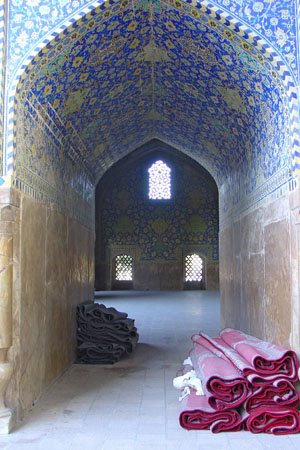
See an image of a mosque under construction in the Iranian capital, Tehran.

Mosque under construction Tehran, Iran

Tehran has over 2,000 mosques, with estimates suggesting around 2,100 as of early 2024, though exact figures vary as some sources mention under 2,000 from earlier years. While there are many, Tehran has a lower density of mosques per person compared to other Iranian provinces, with the highest concentration found in the southern parts of the city.

© Iranvisitor.com