Tourist & Resident Guide to Iran

Friday, December 21, 2007

Imam Khomeini Airport (IKA)

Imam Khomeini Airport (IKA)

Imam Khomeini Airport (IKA), Tehran
Plans to build IKA existed before 1979 but were put on hold after the Islamic revolution. The airport was eventually opened in 2004 and now almost all international flights have been transferred here from the old Mehrabad Airport in central Tehran.

IKA is situated about 30km south of the city on the road to Qom. With no public transport system yet in place, the only way to get there is by private taxi (120,000 Rials, 1hr, Tel.: 021 88738855)

© Iranvisitor.com

Monday, December 17, 2007

Basij Week in Iran

Basij Week in Iran

Basij Week Tehran

This poster is publicising Basij Week which I think has just ended. You may have heard something about the Basij in the news where you are. Human Rights Watch calls them a "parallel organisation" which pretty well sums up their relationship with the government - they're not under direct control but they provide a loyal pillar of support for it in times of need.

In the past this has involved getting heavy with student protests and enforcing codes of conduct and dress in public places. I remember last year seeing a run-in between a group of Basijis and some young men out for a walk in the mountains. The boys were wearing tight clothes and "fashionable" beards that the Basijis found objectionable and they tried to "arrest" them. I didn't stay to find out what happened.

(NB. The Basij are not responsible for the current minor crackdown on "un-Islamic" dress which is going on around Tehran. Those guys are from Ershad (The Council for Islamic Guidance) which is a full government body. Ershad patrols get real police cars and have much more convincing uniforms.)

One way in which the Basiji make themselves conspicuous is on big group outings. I occasionally see them on the way to or from the mountains near wear I live. Here's a clandestine shot of some women Basiji's taken from inside a bus.

Basij Week Tehran

They were part of a coachload of female members all-wearing white and blue checked scarves which signify their support for the Palestinians. At the head of the procession there will often be a standard-bearer carrying a green flag addressing Imam Hossein - the most important of the Shia martyrs. Male groups often chant military-style marching slogans. This all harks back to the time when Basij members provided much of the raw manpower required to kick the Iraqis out of cities like Khorramshahr - a name which still evokes bitter yet proud memories of a time when Iran really was united against a common enemy.

The Basij are still a major part of Iranian society, but I can't help but think they're becoming more and more anachronistic as the Iraq war recedes further into the past. Though scars are still fresh for veterans and especially the families of the shohada (martyrs), it's getting harder now to convince Iranians that they are still at war.

Basij Week Tehran

Iranian government PR is something of a one-trick pony. Replay footage of the Iran-Iraq war and try to make it feel current by blurring it into recent images of dying Gazans. All the patriotically-inspiring if broadcast at half time during international football matches. But the war footage is looking more and more dated now and superimposing Ayatollah Khamenei over pictures of volunteers who never came back just doesn't ring true. The Palestinian conflict is just too far away to evoke the same power of conviction.

With 50% of Iranians just too young to really remember the war, what the Iranian government needs now is a cause. A truly Iranian sacrifice to once again give the Basij a feeling that their world view - a country under threat and therefore in need of repressive conservatism - is correct. And just the possibility (let's not even consider the actuality) of an attack by the U.S. on Iranian soil is just the ticket.

© Iranvisitor.com

Monday, December 10, 2007

BBQ Corn - Vali Asr

BBQ Corn - Vali Asr

On a quiet weekday evening, there isn't really much going on in the streets of Tehran. Not even on the main strip - Vali-e Asr Street.

Barbequed corn on Vali Asr

But this guy was gamely fanning the flames of his makeshift barbecue and wooing passers-by with the prospect of chargrilled sweetcorn. I'd never had it over coals before, and I still prefer it boiled but it's a fun treat nonetheless especially on a cold autumn evening when you can gather around the hot coals and make small talk with other stray folk.

© Iranvisitor.com

Tuesday, December 04, 2007

Neon signs - Vali Asr

Neon signs - Vali Asr

Don't you just love neon on cold, crisp evenings? The shop below is photocopy and print shop and above it is the phone number of a travel agency consisting only of 7s and 8s.

Neon signs - Vali Asr, Tehran

Iranian Music CDs

Guide to Tehran

© Iranvisitor.com

Friday, November 30, 2007

Persimmons in Tehran

Persimmons in Tehran

Seasonal fruit is a great pleasure. There's so much tasteless imported produce in western (and Japanese) supermarkets that probably not that many people know what the right season for most fruit is. But I think Iran is pretty much self-sufficient when it comes to fruit and veg and I certainly look forward to autumn for several of my favourites - one of which is the persimmon which I've heard called "Sharon fruit" before, "kaki" in Japan and "khormaloo" in Iran. Khorma is the Farsi word for "dates" and aloo means "plum."

Persimmons

I wonder if there's a connection there with the Hindi(?) word for potato - something like the French calling them "pommes de terre." Anyway "khormaloo" is a word loaded with sweet winter connotations for me, the colour itself is enough to warm your hands and the sight of abundant orange fruit weighing down leaveless branches and punctuating the air with their fat jolliness is a sure-fire way to put a smile on my face. I think Santa Claus should wear persimmon orange.

Books on Iran

Guide to Tehran

© Iranvisitor.com

Wednesday, October 24, 2007

Iran Tube

Iran Tube

Iran Tube is the Iranian equivalent of YouTube.

Members can upload Iran-related videos. Categories include news, sports, travel and popular culture.

Iran Tube

Iranian Music CDs

Guide to Tehran

© IranVisitor.com

Saturday, September 22, 2007

Afshin Ghotbi to Persepolis

Afshin Ghotbi to Persepolis

Afshin Ghotbi recently left his job as South Korea's national team assistant coach to return to Iran to coach Iranian giants Persepolis.

Afshin GhotbiBorn in Iran, the 43-year-old left his homeland for America in 1977 and went to the 1998 World Cup with the United States and the 2002 and 2006 World Cups with South Korea.

How do you feel about leaving Korea for Iran?
I think I am numb at this moment. I feel excited because of a new challenge and going back to my home country that I haven't seen for 30 years. I also feel sadness because I have so many memories in Korea and so many experiences. It's hard to leave the Korean players as I am always impressed by their mentality and their willingness to learn.

I am excited because I will be head coach of a team and more than that the biggest club in Iran and probably one of the biggest in Asia. They have such history and I remember that as a child. Even when I was a little boy playing in the street, it was always the Reds (Persepolis) against the Blues (Esteghlal).

Read the rest of the Afshin Ghotbi interview here

Iranian Music CDs

Guide to Tehran

Saturday, August 11, 2007

Iran on YouTube

Iran on You Tube

If you typed in "Iran" on YouTube in 2007 coming up No. 1 was a tribute to the country.

The music was by Faramarz Aslani "age ye rooz" - however the video is no longer available due to a copyright claim by Pars video. So instead here is a video by Anthony Bourdain as he samples the delights of Persian cuisine in such dishes as Dizi, Fesenjan, Biryani, and Tahdig.

Iranian Music CDs

Guide to Tehran

© IranVisitor.com

Thursday, July 19, 2007

Iran Reach Asian Cup Second Round

Iran Reach Asian Cup Second Round

Iran Reach Asian Cup Second Round
Iran beat co-hosts Malaysia in Kuala Lumpur to reach the quarterfinals of the Asian Cup as winners of Group C.

Iran scored once in each half to set up a match with South Korea in Kuala Lumpur on Sunday.

Javad Nekounam scored from the penalty spot after 29 minutes and Andranik Teymourian added a fine individual goal ten minutes from time.

Iranian Music CDs

Guide to Tehran

© Iranvisitor.com

Wednesday, June 20, 2007

Kashan Mansions

Kashan Mansions

Kashan is known for its beautiful, restored mansions. They seem to rise out of the earth.

Kashan traditional house

Guide to Tehran

© Iranvisitor.com

Friday, June 08, 2007

Still Incomplete Milad Tower

Still Incomplete Milad Tower

Still Incomplete Milad Tower.

The still incomplete Milad Tower looks out over one of Tehran's busy public transport junctions.

Finally completed in October 2008, the Milad Tower (Borj-e Milād) is Tehran's iconic, 435-meter-tall multi-purpose tower, serving as a major telecommunications hub, cultural center, and tourist attraction, featuring observation decks, restaurants (including a revolving one), museums, and various entertainment facilities, making it the tallest tower in Iran and a symbol of modern Tehran.

Guide to Tehran

© Iranvisitor.com

Existential graffiti in Iran

Existential graffiti in Iran

Existential graffiti in Iran.


Roughly translated:

I write to leave a reminder
So that if I disappear one day
A reminder it will stay

Guide to Tehran

© Iranvisitor.com

Thursday, June 07, 2007

"Eeenja Iran-e!" (This is Iran!)

"Eeenja Iran-e!" (This is Iran!)

This is an excuse I hear a lot when things are not the way they should be. It's usually employed once a solution to a problem is identified and thoughts turn to putting it into practice.

This is Iran!

"But this is Iran!" It's not as easy as that! Sure, that's the problem and this is the best way to get around it but this is Iran. Don't expect things to go so well....

[ followed by any/all of Iran's 3 great national excuses.]

1. First of all people 'don't have culture' here [the Farsi word for this is 'bifarhang' which has no direct translation] they don't know how to behave. You tell them one thing and they do another. They're uneducated and they don't know how to follow rules....

2. And the government doesn't let people get on with their lives. One day one politician launches a policy, the next day he's gone and his replacement wants something else. He gives government jobs to all his cronies and they start filling their pockets and before they've had enough so they can really start work their boss gets the sack and another politician/set of cronies starts all over again!

3. Do you expect the West would let us improve? We were developing a perfectly good democracy until the US stepped in and took away the only decent leader we'd had since Abbas the Great [meaning Mohammad Mossadegh]. And the British are twice as cunning.... Everyone knows George Bush is in Tony Blair's pocket. The mullahs all take their orders from England. It's been like that for centuries and don't think it's going to change soon!

Guide to Tehran

© Iranvisitor.com

Monday, May 21, 2007

Uptown Real Estate Tehran

Uptown Real Estate Tehran

Uptown Tehran

Another pic from the rooftops. This is uptown Tehran. You can make out the slope up to the Alborz mountain range in the background. Basically, if you have the money, you get cleaner air. But Tehran real estate is prohibitively expensive for most Iranians and prices just get higher. And so do the construction projects. Here's a tower block going up on Afriqa Avenue (also known as Jordan) - a fashionable, traffic-clogged boulevard flanked by some of the most expensive property in the country.

Guide to Tehran

© Iranvisitor.com

Tehran From Above

Tehran From Above

Tehran from above
On a clear day you can see mountains from everywhere in Tehran.

Guide to Tehran

Saturday, May 12, 2007

More Japanese Visit Iran in 2007

More Japanese Visit Iran in 2007


More and more Japanese are planning to visit Iran in 2007, according to PressTV.

More Japanese Visit Iran in 2007

More Japanese Visit Iran in 2007

More Japanese Visit Iran in 2007


Guide to Tehran

Tuesday, May 08, 2007

Nuclear banknote

Nuclear banknote


Iran's central bank has issued a 50,000 Rial note with a nuclear symbol motif.


The back of the note features a symbol representing electrons circling a nucleus superimposed over the map of Iran. Alongside it is a quote from the Prophet Mohammad which runs, ""if the science exists in this constellation, men from Persia will reach it."

Guide to Tehran

© Iranvisitor.com

Saturday, May 05, 2007

Giveh: Iranian summer footwear

Giveh: Iranian summer footwear

Giveh: Iranian summer footwear.

Just in time for summer, I've bought myself a pair of giveh, the ideal shoes for the long, hard Tehran summer. Giveh have been made for centuries in many parts of Iran but are most famously from Western Iran, particularly a town called Paveh in Kermanshah Province.

The upper is made of strong tightly woven cotton sewn tight to (on my pair) a leather sole. The soles of traditional are made of tightly compacted layers of cotton material stacked from toe to heel. These are less practical since they can lose their shape if wet.

Giveh are, however, very much dry weather footwear. Made almost entirely from cotton, there's no need to wear socks and feet breath easily. In fact, in the town where my giveh were made they are referred to as jurab (socks) rather than kafsh (shoes).

Isfahan Weather

Tehran Weather

Guide to Tehran

© Iranvisitor.com

Friday, April 20, 2007

Kermanshah Sheep

Kermanshah Sheep

Kermanshah, in central west Iran, is known for its large flocks of sheep.

Kermanshah Sheep.

The sheep have a dual purpose: meat from the animals is consumed locally and much of the surplus is sent to the capital Tehran, sheep wool is also used in the production of the famous geometric-designed carpets of the area.

Kermanshah carpet design is significantly influenced by the culture of the local Kurds and Loris who live in the area.

Sheep and goats number around 81 million in Iran, according to 2005 figures, and outnumber the 71 million humans in the country.

Sheep have been a prominent part of the culture of Iran for centuries. A clay image of a sheep that was found at Sarab in Iran dates back to 5000 BCE.

Iran cloned its first sheep in 2006 at Tehran's Royan Institute, though the animal lived only a few minutes before it could be named.

Guide to Tehran

© Iranvisitor.com

Wednesday, April 18, 2007

Iranian reactions to the movie 300

Iranian reactions to the movie 300

Iran's mission to the UN has issued a statement criticising the movie "300", calling it "a thinly-veiled attack on Iranian history." The full text was published on Irna news.

The statement expresses what many Iranians feel about a film that most haven't even seen yet - that misrepresentations of Iran in Western media are something close to a deliberate campaign to present Iran as "a dangerous, bestial force fatally threatening the civilized 'free' world." Government Spokesman, Gholam Hossein Elham, described it as a "cultural intrusion" and said the government interpreted it as "hostile".

Iranian reactions to the movie 300

I was at a talk held at the Khaneye Honarmandan artists centre where a mercifully edited version of "300" was shown to an audience mainly of university students. Listening to the talk that followed, I was struck with just how intensely felt, yet deeply vulnerable, the Iranian sense of national identity was.

During the screening the mood was light. When King Khashayarshah (Xerxes), a three-metre-tall drag queen, stepped-off his medieval hovercraft, the audience laughed along with Leonidas' raised eyebrow. The anticlimactic end of the Persian attack rhinoceros was another amusing highlight. I noticed a number of other representations that could be interpreted as more serious insults. For me, the ape-like masks of the "eternal warriors" sent a potentially racist message. Furthermore, referring to the Persian army as "slaves" belies the historical truth that the Persian Empire was, unlike Greece, Rome and Egypt, not dependent on slavery.

Iranians live under a persistent irony. Their country's glorious past casts a long shadow over the Iran of modern times. Every Iranian will relate with pride and confidence in the historical facts that the Iranian empire was the first and largest of ancient times and, at its height, stretched from Greece to China. They cite great leaders whose names were suffixed with "the Great" as rulers with enlightened ways who led their people with intelligence and fairness. What's more, every time foreign powers invaded Iran, either the invaders themselves effectively became Iranians (Mongols, Turks) or Iranian culture simply resurfaced in new forms to absorb the invading culture (Arabs).

But far from blaming westerners for not accurately representing an ancient civilization to which they owe such a huge debt, the Iranians in the audience expressed a deeply self-critical attitude. One woman asked why so few of her countrymen and women attended a protest against a dam-building project which was set to submerge an important archaeological site. Another hit on another very deep vein of dissatisfaction citing many examples of how Iran's pre-Islamic history was being downplayed. Why, for instance, were there no roads named after Kouroush (Cyrus the Great) while so many were named after clerics made famous by the Islamic revolution or Iran-Iraq war. When the current of discussion threatened to break out into open criticism of the government, the chairman had to reign it in. He mentioned that, if the attendees appreciated the facilities provided by the Khane Honarmandan, it would be advisable not to turn it into a base for political debate.

A more lighthearted response to the film comes from Iran's best known satirical cartoonist, Touka Neyestani. Thanks to Zeynab's sister for the following translation:

I simply don't understand why my Iranian friends were upset by this film. After all, it's not the first time that Hollywood has done this. It has been doing it to Native Americans, blacks, Arabs, Germans, Japanese,... etc for years. Just last year we all saw "Borat" and we all laughed.

© Iranvisitor.com

Thursday, March 08, 2007

Eid-e-Nowruz goldfish

Eid-e-Nowruz goldfish

Eid-e-Nowruz goldfish.

The build up to Eid. Darakeh's walnut and almond seller is branching out into the New Year goldfish market.

Goldfish are not one of the haft sin but still an indispensable part of the festive spread that every Iranian family displays at this time of year. They are said to represent the unexpected favours to be received in the coming year. Traditionally, they are set free in rivers when the holiday period ends. Some people take theirs to the ponds at mosques and shrines. My aunt’s goldfish from Nowruz 2006 is still going strong and will be making a comeback appearance this year.

© Iranvisitor.com

Post Office Vali-Asr Square

Post Office Vali-Asr Square, Tehran

Post Office, Vali-Asr Square.
Iran’s postal service is reliable and efficient. Sending packages internationally requires identification in the form of a passport. Bring your package unsealed as contents will be checked before dispatch.

© Iranvisitor.com

Wednesday, February 07, 2007

Remembering the Martyrs of the Iran-Iraq War

Remembering the Martyrs of the Iran-Iraq War

Remembering the Martyrs of the Iran-Iraq War.

The scars of a war as devastating as the Iran-Iraq War (1980-1988) do not easily heal. Some counts put the number of Iranian casualties 300,000 with another 500,000 wounded. The number of Iraqi dead numbered around 375,000.

The Iranian establishment refers to the war as the “Iraq-imposed war” and Iran’s part in it is known as the “Sacred Defense”. Hence, Iran's war dead are shahid (martyrs). Shiite Islam, so steeped in the culture of mourning, gives them a place alongside the paradigmatic holy victims; Imam Ali and Hossein.

Tehran is dotted with large painted murals commemorating the most famous of the Iraq war martyrs. Their fixed gazes tell nothing of the conflict that robbed them of their lives. The colours have faded with time but their complexions remain unaging.

Remembering the Martyrs of the Iran-Iraq War.

Guide to Tehran

© Iranvisitor.com

Tuesday, January 30, 2007

Ghaliyan

Ghaliyan


The Ghaliyan - or hookah as it is more widely known - is a water pipe used for smoking tobacco. Ghaliyan is still very much a part of popular culture in Iran – in fact you see more young people smoking it than old. You can smoke ghaliyan at working-class teahouses and at traditional restaurants where it is served to your table or rug with dates, sweets and of course tea. Places like these quickly fill with the sweet aroma of scented tobacco. Many Iranians – especially young men – bring their own on mountain walks and picnics, take coals from the barbecue and share a smoke after lunching on chicken kababs.

Hookah pipe in Iran
The pipe consists of several parts; a glass jug part-filled with water, a wooden, earthenware or metal stem fitted tightly to the jug, a brazier at the top of the stem for coals and tobacco and a hose with a mouthpiece attached to the jug above water level.

When you suck the mouthpiece, air is drawn past the coals in the brazier and this heats the tobacco. Smoke from the burning tobacco is then pulled down into the water jug where it is cooled and partly filtered of tar and other impurities. After bubbling up through the water (the sound it makes gives ghaliyan its other popular western name – hubbly-bubbly) it passes through the hose.

Traditionally the ghaliyun is used for smoking plain tobacco that you can still see in bazaars in the form of dry, brown folded leaves. These leaves have to be soaked before smoking. Now though, the most popular form of tobacco is the scented, flavoured variety which comes in a sticky paste wrapped in plastic and packed into small boxes. Some popular flavours are na’ana (mint), do-sib (two apples) and portogal (orange).

Friends smoking a hookah pipe

© Iranvisitor.com

Sunday, January 28, 2007

Persian Carpets

Persian Carpets


The seven main centers for the production of Persian carpets in Iran are Tabriz, Mashhad, Qom, Kashan, Nain, Esfahan, and Kerman.

Persian carpet.

In Iranian culture carpets signify much, much more than just a floor covering.

Carpets in Iran symbolize wealth, investment and religious devotion. The earliest surviving Persian rugs date back to the Safavid Period.

Persian carpets are traditionally woven from wool or silk and have a long history of production and international trade on the ancient Silk Road, which passed through Persia between China and the West. Persian carpets have long been treasured by the rich in both the Far East and Europe.

Persian carpet.

Carpet motifs are classically symmetrical and often floral, symbolizing the design of classical Persian gardens.

Persian carpets are produced in three main sizes:

- mian farsh: 3m x 2.5m
- kellegi: 3.5m x 2m
- kenareh: 3m x 1m

Terms:

Gabbeh rugs - a colorful carpet often produced by nomadic tribes
Kilim - flat, geometrically patterned and woven rugs

Most Persian carpets are hand-woven on vertical looms by mainly female artisans from sheep or goat wool and occasionally from camel wool.

Persian carpets contain on average up to 30 knots per square centimeter.

Persian carpets are available for sale in their centers of production in Iran and from the bazaars of Tehran, Esfahan and Shiraz.

The Carpet Museum in Tehran provides the visitor with an excellent insight into the history of Persian carpet production, styles and techiniques.

The world's largest Persian carpet is the Ardebil Carpet.

Persian carpet.

Further information see Kimiya International

Travel Guide to Tehran

Travel Guide to Esfahan

© Iranvisitor.com

Thursday, January 25, 2007

Bridal SUV in Tehran

Bridal SUV in Tehran, Iran


Bridal SUV.
Iranian weddings are floral feasts and the car that gets the bride and groom to the ceremony is always elaborately festooned.

Travel Guide to Tehran

Travel Guide to Esfahan

© Iranvisitor.com

Masuleh Gilan Province Iran

Masuleh Gilan Province Iran

Masuleh Gilan Province Iran.

Though Masuleh is one of Iran’s most valued architectural treasures it is also one of its humblest. Here it is not the sweeping vision of a master architect or the glory of a great king that tourists flock to appreciate, but the simplicity of a traditional village in a spectacular location untouched by the modern age.

Masuleh is located about a one and a half hour drive away from the city of Rasht, less than an hour away from Fumn, in the foothills of Mount Talesh. In fact, the village literally grips the mountainside, hanging on as if it were in danger of plunging into the river at its foot.

The architectural style that makes Masuleh special can be seen elsewhere in Iran but not so perfectly preserved. In order to accommodate houses, a bazaar, 18 mosques and all the facilities of a village of just under 2,000 inhabitants, the roofs of many buildings double up as the streets of the level above.

The height difference between the lowest and the highest points of this stepped village is about 100 metres. The car park at river level is as far up as motor vehicles can go – this being the only village in Iran in which automobiles are completely banned.

Much is being done in Masuleh to maintain buildings in the old ways. Every year walls get a fresh coating of mud, giving the whole village an organic feel - as if the buildings have grown out of the earth of the streets.

At the heart of the town is the bazaar which is a lively nest of alleys and stairways with cubby-hole shops selling a wide variety of handicrafts, freshly-baked sweets, a worrying preponderance of knives and all weaves and colours of silk scarves. One level above the bazaar are a number of restaurants and teahouses where you can lunch on kabab followed by tea and gheliyoon.

Masuleh Gilan Province Iran.

Stray up further and your chances increase of having a grumpy local chide you for not sticking to the "tourist areas". Not everybody here is glad of the attention that their picturesque little town brings. However, most of Masuleh’s inhabitants welcome the interest in their village and some even open their homes to guests for meals or overnight stays.

Travel Guide to Tehran

Travel Guide to Esfahan

Books on Iran - Fiction, Politics, History, Islam

© Iranvisitor.com

Sunday, January 14, 2007

Iran News 1/14/07

Iran News

The BBC has three stories on Iran this week.

The first details the effects of traffic and new construction on the historic city of Isfahan.

Iran News 1/14/07

The cheap price of oil and the effects of pollution from cars leads to thousands of deaths in Tehran from smog every year.

Lack of job opportunities is leading to an estimated brain drain of 150,000 people each year leaving Iran.

The Iran Daily highlights "Clean Air Week in Tehran" to combat the threat of car pollution.

The Fars News Agency reports that the Iranian government has passed into law a regulation raising the voting age in local elections from 15 to 18.

Travel Guide to Tehran

Travel Guide to Esfahan

Iran map.

© Iranvisitor.com

Friday, December 22, 2006

Iran's Azeri Turks

Iran's Azeri Turks

If you hear a language other than Farsi on the streets of Tehran, most likely it's Azeri Turkish. Closely related but not identical to the national language spoken in Turkey, Azeri is spoken as a first language by about 20% of the Iranian population, mainly concentrated in the provinces of Eastern and Western Azerbaijan but it is also very commonly spoken in the capital. Estimates of just how many Iranians are ethnically Azeri Turks vary widely. One very commonly quoted statistic makes Azeris the largest single population group in Iran, making up 30 million of the country's population of 70 million.

Iran's Azeri Turks

Turks are stereotyped by other Iranians as flashy with their wealth and Turkish women are said to be great cooks and hardworking wives but rather expensive to maintain. Sadly, Turks are also widely ridiculed as being congenitally stupid. Jokes about Turkish simpletons make up a large majority of the new jokes circulating around schoolyards, workplaces and universities. Turks are also ribbed for not being able to pronounce the Farsi letters "(ghayn)" and "(jim)".

The Islamic Republic, as well as the Imperial Government before it, has tried to play down differences between Iranians and Azeris - perhaps fearing that an awakened sense of Azeri nationalism could threaten them. The Azeri language is not taught in schools, not even as an optional second language. Ironically, many powerful members of the political establishment - including Supreme Leader Ayatollah Ali Khamenei - are themselves Azeri Turks.

Turks have also experienced more serious persecution in modern Iran. In 1981, an uprising in Tabriz was brutally put down by the new government with heavy weapons and summary executions. However, on the whole, Iranian Turks do not have a strong urge towards separatism. The vast majority consider themselves as Iranian as Farsi speakers do.

The Cartoon Controversy

The most recent clash between Turks and the government came in the summer of 2006 when a cartoon published in the Iran Daily newspaper depicted an Azeri cockroach failing in an attempt to learn the Farsi language. The inflammatory image was not taken at all lightly by Azeris who took to the streets of Azerbaijan's major cities in thousands. Newspapers were burnt and offices of the offending publication were surrounded by angry protesters. In the end, the editor of the Iran Daily was sacked and President Ahmedinejad himself travelled to the region to patch up relations. The importance of up to 30 million voters clearly made the trip worthwhile.

Travel Guide to Iran

Iran map.

© Iranvisitor.com

Friday, December 01, 2006

"Aash" restaurant Enghelab Square Tehran

Aash restaurant Enghelab Square Tehran

Aash Restaurant, Enghelab Square

Known to all Tehran University students and frequented by artists and bazaar traders alike, this "aash" restaurant is my current favourite spot for lunch in the city.

There are just two versions of the thick soup dish on offer and you get the feeling it's been that way for years. There's aash-e reshteh which is meatless and heavy with beans, pulses, herbs and wheat noodles and a minced meat-rich slop originating from Isfahan that I forget the name of. Both weigh in at a slim 500 Tomans.

The guy at the counter has served so many bowls that he won't even look at you until your money is on the counter. Once you get (or rather your cash gets) his attention he'll fill your bowl and dash kashk (a kind of dairy product something like a super-rich yogurt) and mint sauce over it and hand you half a naan-e barbari (see previous post).

Located on the northeast corner of Enghelab Square. Climb down the stairs and you'll see the two huge vats right in front of you.

Travel Guide to Iran

Guide to Tehran

© Iranvisitor.com

Sunday, November 26, 2006

Barbari Bread

Barbari Bread

barbari bread

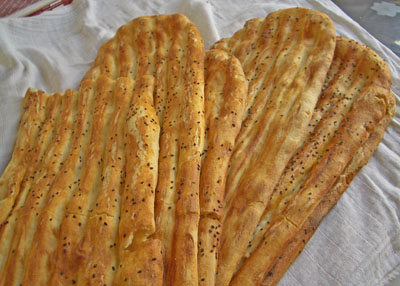
This is "naan e barbari", one of the breads that is available fresh all over Tehran and Iran. It's crisp and golden on the outside and soft and white in between the crusts. Usually quite generously salted, barbari is tasty enough to eat on its own and one of the perks of going to buy it is the right to eat it piping hot on the way home. You can see from the picture that I've helped myself to the "head" of the loaf on the left.

It's often said that no matter how hard hard up you are for cash, you can always treat yourself (and/or a friend) to "barbari o nushabe", that is, barbari bread and fizzy drinks.

Travel Guide to Iran

© Iranvisitor.com

Tuesday, November 07, 2006

Buses in Tehran

Buses in Tehran

Tehran city bus
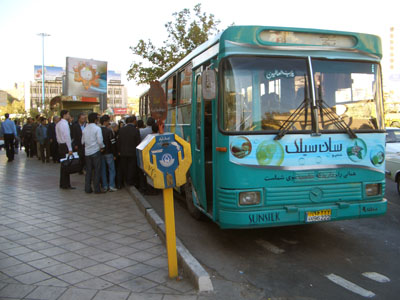
There's probably no need for tourists to take buses in Tehran. But for those living and working in the city they are a great help. Private taxis are unaffordable for most and even shared taxis are expensive for many. So the bus - being practically a free ride - is a necessity.

Tickets are bought from manned (usually an old man!) kiosks at major transport intersections and they cost 200 Tomans (about $0.20) for 10.

One thing that might bother foreign visitors is the sex segregation. Women ride in the back and men in front. Some might find it ironic that in minibuses and shared taxis no such pains are taken to separate men and women.

There are no signs in English and I've only once ever seen a map that showed bus routes - labelled, of course, in Farsi.

Map of Tehran

Travel Guide to Iran

Guide to Tehran

© Iranvisitor.com

Saturday, November 04, 2006

Iran Travel Bonus

Iran Travel Bonus

The Iranian government is offering cash bonuses to the country's travel agencies to lure foreign tourists to the country.

The Iranian news agency reported that the Tourism and Cultural Heritage Organization will offer US$20 for every American or European tourist who visits the country with a US$10 offer for every Asian tourist.

Iran Travel Bonus

Iran is looking to expand its tourist industry especially for visitors from the USA and Europe.

President Mahmoud Ahmadinejad has come out against planned legislation to require US travelers to be fingerprinted at the nation's airports.

Travel Guide to Iran

© Iranvisitor.com

Monday, October 23, 2006

From the Ceasefire Campaign

From the Ceasefire Campaign

From the Ceasefire Campaign.

Dear Friends,

North Korea's nuclear test last week showed that policies of isolation and threats of regime change will not prevent the spread of nuclear weapons. We need to act quickly, before the Bush
Administration makes the same mistakes in Iran. The UN Security Council is scheduled to discuss sanctions on Iran this week, making it critical to get as many people as possible involved in this campaign over the next few days, while world leaders are debating their options. Click below to send a message to President Bush, calling on the US to enter direct negotiations with Iran:

www.CeasefireCampaign.org (no longer functioning website)

The last thing the world needs is a global nuclear arms race, so let's seize this moment to show the Bush Administration that the world has a stake in resolving things with Iran peacefully ­ and will hold him accountable.

Talks between the US and Iran won't guarantee a solution to the nuclear problem, but no talks will guarantee failure. There is no military solution to this issue, and President Bush's aggressive policies have begun to spark a global nuclear arms race, as countries rush to build nuclear weapons. There have been several calls, even from prominent members of Bush's own Republican Party, to change course. Join this rising chorus by clicking below:

www.CeasefireCampaign.org

The Bush Administration is starting to learn that it ignores global public opinion at its peril. Let's send a strong message to President Bush ­forward this email to your friends and family, and encourage them to help prevent the nightmare of a new global nuclear arms race from becoming reality.

Thanks!

Thursday, October 12, 2006

Government clamps down on ADSL use

Government clamps down on ADSL use

The Iranian government has instructed providers of ADSL internet services to limit private users and internet cafes to a maximum connection speed of 128kps. No reason has been given for the new ban but it follows in the footsteps of an intensification in internet content filtering.

The new restriction will effectively prevent internet users in Iran from receiving multimedia content such as foreign news and entertainment broadcasts and will also make downloading large files more difficult.

The Telecommunications Ministry has said the order will stay in place until "new regulations for providing ADSL services" were issued. It is still not clear whether this means the restriction will stay in place but ADSL providers and users are not expecting the decision to be reversed.

High-speed internet connections of 256kps and 512kps had been available in Iran for little more than one year before the current order was issued in mid-October.

© Iranvisitor.com

Friday, September 29, 2006

The Helmi Drum Showroom Tehran

The Helmi Drum Showroom Tehran

Ostad Helmi and his tonbaks
Ostad Helmi, pictured here in his home/showroom, produces most of the tonbak drums in Iran. His walls are hung with a tremendous assortment of traditional musical instruments from Iran and elsewhere. In the gaps are photographs of memorable occasions from his long career.

tars on the wall

I visited Mr. Helmi to buy my own drum last week. A percussionist friend of mine accompanied me and recommended an udu - a clay jar drum with a circular hole which, when struck correctly, makes a kind of gulping-air sound. Production of this African-style drum has recently been started in Iran. Though fun to play, the udu didn't have quite enough volume for my liking.

So after testing out a few instruments, I finally settled for one of Ostad Helmi's famous tonbaks. It is mainly played with the fingers and has a low, breathy "ton" sound when played in the centre and a much higher, crisp "bak" sound when played near the edge.

helmi tonbaks
It is a goblet-shaped drum that can be made from a wide variety of woods and skins. It is one of only two distinctively Iranian drums - the other being the daf - and is mainly seen accompanying traditional Iranian music ensembles.

I'm not sure I'm yet playing it in quite the way it was intended but it certainly feels great to bang on a drum! Thanks Mr. Helmi!

Guide to Tehran

© Iranvisitor.com

Saturday, September 16, 2006

The Ardebil Carpet

The Ardebil Carpet


the reproduction Ardebil CarpetThe floor of the shrine to Sheikh Safi od-Din in Ardebil, northwest Iran, is covered with a reproduction of the most famous carpet in the world - the Ardebil Carpet.

Facts about the Ardebil Carpet
  • Originally woven as a pair in either 1540 or 1586 making it one of the oldest carpets still in existence.
  • The carpets were commissioned by Shah Tahmasp (1514-1576) who ruled Iran from the age of 10. They would have taken about 4 years to complete.
  • They covered the floor of the Sheikh Safi Shrine for 3 centuries before being bought by a British traveller in 1890.
  • They each measure 10.5m by 5m and contain some 30 million knots.
  • The lamps at either end of the design are different sizes to create an illusion of perspective – this is because they were intended to be viewed primarily from one side.
  • The 19th century British designer and socialist William Morris called it "the finest eastern carpet I have seen". It was he who persuaded the Victoria & Albert Museum and public donors to raise £2,000 to purchase it – at the time an enormous sum.
  • It is thought that the V&A Ardebil was restored using parts of its twin.
  • The V&A carpet has recently been laid on the floor for the first time in over a century as the centerpiece of the new Jameel Gallery of Islamic art. The room in which it is displayed is fully lit for only 10 minutes every half hour.
  • The sister carpet was purchased in 1931 by J. Paul Getty who later donated it to the Los Angeles County Museum of Art.
  • Modern carpet weavers were paid 100,000,000 Tomans to reproduce it for display at the Ardebil Shrine.
  • There is a copy of the Ardebil carpet in 10 Downing Street and Adolf Hitler had a copy in his Berlin office.
  • Both of the original carpets are signed and dated with an ode by the 14th century poet Hafez:-

I have no refuge in this world other than thy threshold
My head has no resting place other than this doorway


© Iranvisitor.com

Sunday, September 03, 2006

Images: Ancient History of Iran

Images: Ancient History of Iran


A huge variety of bric-a-brac is on display at Tehran's Jomeh Bazaar (Friday Market). Iran's last monarch and his wife are pictured here among the antiquities - very much part of the past.

Shah's coronation photos, Jomeh Bazaar

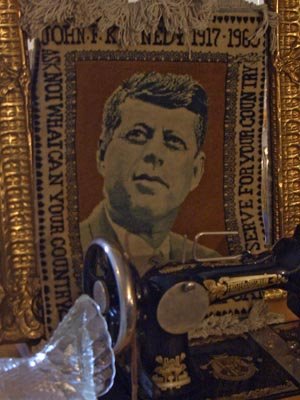
Another iconic figure of the 20th century, this time commemorated on a specially woven Persian rug.

JFK carpet

Tehran Sightseeing Guide

© Iranvisitor.com