Tourist & Resident Guide to Iran

Monday, January 26, 2026

Iranian Music: Daf

Iranian Music: Daf

The daf (Persian: دف), also known as dâyere or riq, is a traditional Iranian frame drum used in both popular and classical music. It is widely played across Persian-influenced regions of South and Central Asia, including Iran, Afghanistan, Azerbaijan, Tajikistan, Uzbekistan, parts of Georgia and Armenia, Pakistan, and areas of India.

The daf.

The daf is the other of Iran’s indigenous drums – the other is the donbak which I've already talked about elsewhere.

As you can see from the picture, the daf is a wide, circular, frame drum. Inside the frame of the drum are hundreds of metal rings in short chains. The player beats the drum with his fingers while supporting it in his palms.

With the movement and beating of the daf, the rings inside the frame strike the skin – the same way as the springs of a snare drum work. The sound is a combination between a bass boom caused by the hand and a high-pitched crash from the rings. The daf is a drum for dancing to. Indeed, it is the drum to which Sufi mystics dance the whirling, trance-inducing dance known as sama.

© Iranvisitor.com

Sunday, January 25, 2026

Useful Sites on Iran & Iranian Culture

Useful Sites on Iran & Iranian Culture

Here is a listing of websites in English we recommend on Iran and Iranian culture. If you think we have missed something please let us know.

Useful Sites on Iran & Iranian Culture

Iranian Art & Exhibitions

britishmuseum.org (Ancient Iran Collection)

Iranian Culture

iranchamber.com

Food

familyspice.com/persian-recipes

tasteatlas.com (Where to Eat Locally)

Iran News

aljazeera.com/where/iran

bbc.com/persian

farhangsara.com

farsnews.ir

ifpnews.com (Iran-based news agency)

iransource (Atlantic Council - Washington DC-based think tank)

iranWire.com (Independent reporting)

irna (Islamic Republic News Agency)

parstimes.com

presstv

tehrantimes (state-affiliated)

Azadi stadium, Tehran.

Iran Sport

persianleague.com

soccerphile.com

Iran Travel

surfiran.com

lonelyplanet.com/iran

Iran map.

© Iranvisitor.com

Saturday, January 24, 2026

Iranian Embassy Tokyo

Iran Embassy, Tokyo

The Iranian embassy in Tokyo is housed in a modern building in Hiroo.

Iran Embassy, Tokyo

Access
3-13-9, Minami Azabu,
Minato-ku
Tokyo 106-0047
Tel:(03) 3446-8011/15

japan.mfa.gov.ir

Hiroo Station on the Hibiya Line (15 mins walk) or Shiroganetakanawa Station on the Nanboku Line (10 mins walk).

© Iranvisitor.com

Friday, January 23, 2026

Stained Glass In Iran

Stained Glass In Iran

Stained glass is used in many mosques in Iran often in beautiful patterns. Shiraz is particularly well-known for its stained glass.

Stained Glass in Iran.

Reflections from stained glass in Shiraz.

Stained glass in Shiraz.
Guide to Tehran

Sitemap - list of posts on Iran

Iran map.

© Iranvisitor.com

Wednesday, January 21, 2026

Tasbi (prayer beads)

Tasbi (prayer beads)

Tasbi prayer beads.

Strings of prayer beads are known as tasbi in Iran and here are some on sale in Tajrish bazaar. Most often they are seen dangling from the hands of middle- to old-aged men who tend to fiddle with them rather aimlessly.

However, for devout grandmothers, they are indispensable tools for tallying the number of prayers required to get a grandson into university or a sister out of her sickbed.

More on Tasbi(h)

Tasbih beads, also called misbaha or subha, are prayer beads used by Muslims to count recitations of praise and remembrance (dhikr) for Allah, helping to maintain focus and enhance spiritual connection during devotion. Typically featuring 99 beads (or 33, cycled three times), they are used to count phrases like "Subhan Allah" (Glory be to God) or "Alhamdulillah" (Praise be to God), and often include a leader bead (imame) and a tassel.

© Iranvisitor.com

Tuesday, January 20, 2026

Cars in Iran

Cars in Iran

According to a 2004 report in the Iran Daily, Iran would have 25 million vehicles on its roads by the year 2020 up from the 2004 figure of 5.4 million. Of this number, approximately half are crammed in to the capital Tehran.

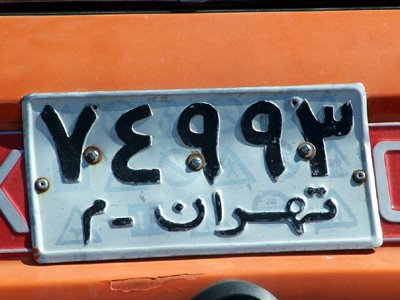
Iran License Plate
Cars in Iran

Iran has had its own car industry since the 1960s and now exports cars to a number of other countries including Russia and Belarus. Iran Khodro Industrial Group, the country's major vehicle manufacturer, hopes to export 250,000 cars to the world market by 2010, targetting such countries as Egypt, Turkey and Eastern Europe as areas of growth with plans for joint production ventures under license in such countries as China, Senegal and Syria.

Iran's first mass-produced car, the ubiquitous Paykan, based on the 1966 Hillman Hunter, was produced domestically by Iran Khodro from kits shipped by the British manufacturer Rootes. In 1978 Peugeot took over the defunct Rootes Company, and production was shifted under license to Iran, ceasing only in 2005.

Car on a building.

The Paykan has been superseded by Iran Khodro's new model, the Samand, which is based on the Peugeot 405. Plans are underway to produce a hybrid version of the Samand under pressure from the government to reduce vehicle emissions in Iran.

Iran has a significant domestic car manufacturing industry, producing over a million vehicles annually, primarily through large state-influenced companies like Iran Khodro (IKCO) and Saipa, making it one of the world's largest automakers despite relying heavily on older designs and licensed technology from international partners like Peugeot and Renault.

Visitors can also still see old American cars from the 1970s here and there.

© Iranvisitor.com

Persimmons in Iran

Persimmons in Iran

Persimmons (khormaloo) are a popular autumn fruit in Iran.

Persimmons in Iran

© Iranvisitor.com

Monday, January 19, 2026

Sistan and Baluchestan Province

Sistan and Baluchestan Province

Sistan and Baluchestan is the largest of Iran's thirty provinces by area. Sistan is the area to the north and Baluchestan lies to the south bordering Pakistan.

Sistan and Baluchestan Province

The province as a whole has a population of over 4 million people and is one of the driest and poorest areas of the country. Zahedan, with over half a million inhabitants, is the provincial capital and it is possible to pick up visas here for both neighboring Pakistan and India.

Zabol (pop. 132,000) is an exotic and dangerous border town with Afghanistan to the north of Zahedan.

There are flights to both Zahedan (daily) and Zabol (weekly) from Tehran. There are shared taxis (savaris) from Zahedan to Zabol.

Iranian Music CDs

Guide to Tehran

© Iranvisitor.com

Sunday, January 18, 2026

Images: Moraq Mosaic Tiles

Images: Moraq Mosaic Tiles


Moraq Mosaic Tiles.
Moraq Mosaic Tiles

This isn’t a historical building by any means. It’s just a decoration on the outer wall of the compound of an official building on Valiasr Avenue. It is, however, a nice example of the Moraq (mosaic) style of Iranian tilework in which small pieces of glazed tile are placed closely together over a previously laid-out pattern to form a decorative panel which can then be cemented to a wall.

This form of tilework reached its peak in the Timurid Period (14-15th century CE) and can be seen on monuments in Iran such as Goharshad Mosque in Mashad, (1418 CE), the Jom'eh Mosque of Yazd (1456 CE), the Jom’eh Mosque of Varamin (1322 CE) and the Khan Madreseh in Shiraz (1615 CE).

More on tiles as soon as I get some good pics!

Photographs of Iran

© Iranvisitor.com