Tourist & Resident Guide to Iran

Friday, October 10, 2008

Milad Telecommunications Tower

Milad Telecommunications Tower

The Milad Telecommunications Tower (Borj-e Milad) opened this week in Tehran. At 435 meters, the tower is the 4th largest in the world.


Milad Telecommunications Tower.

Designed by architect, Dr. Mohammad Reza Hafezi, the tower is part of the new Tehran International Trade and Convention Center. The tower has restaurants at the top with amazing views of Tehran below.

Milad Telecommunications Tower.

The Milad Tower is designed to withstand earthquakes of 7.5 on the Richter scale.

Iranian Music CDs

Guide to Tehran

© Iranvisitor.com

Friday, September 12, 2008

South Khorasan Province

South Khorasan Province

South Khorasan Province is located in the extreme east of Iran bordering Afghanistan. The main towns of the province are the provincial capital Birjand, Ferdows, and Gonabad.

South Khorasan Province

The previous province of Khorasan was the largest province of Iran until it was divided in 2004 into North Khorasan, South Khorasan, and Ravazi Khorasan.

Birjand has a population of approximately 160,000 inhabitants and Birjand Airport has flights to Tehran and Mashhad.

Iranian Music CDs

Guide to Tehran

© Iranvisitor.com

Friday, August 22, 2008

Iran Collection British Museum

Iran Collection British Museum

The British Museum in London has some of the finest pieces of ancient Persian art outside of the National Museum in Tehran.

Iran Collection British Museum

Many of the pieces were excavated by Robert Gordon from Persepolis in the early 19th century.

Iran Collection British Museum.

The citadel of Persepolis was constructed by Darius I around 500 BCE and the iconography of the sculpures and relief works included influences from Egypt, Greece and Mesopotamia. Persepolis was destroyed by the Macedonian invader Alexander in 330 BCE.

Iran Collection British Museum

British Museum

Guide to Tehran

© Iranvisitor.com

Thursday, July 17, 2008

Iran-Japan Relations

Iran-Japan Relations

When President Khatami visited Tokyo in 2000, he was the first Iranian leader to visit Japan since King Reza Shah Pahlavi in 1958. At the time, he and the Japanese premier, Mr Mori, made plans for friendly relations and greater economic cooperation.

Iran-Japan Relations

According to official Iranian statistics, the volume of bilateral trade between Japan and Iran reached US$14.3 billion in 2007 and this is expected to increase to US$20 billion in 2008 as a result of rising oil prices.

At the people-to-people level, things look positive. There are 5,227 Iranians officially registered as living in Japan and around 300 Iranian students. According to Ambassador Araqchi, academic exchanges between the two countries 'play a vital role for further deepening of our relations.' Culturally, there has also been some interesting collaboration in areas such as cinema - for instance, the 2003 movie 'Kaze no Jutan' (The Wind Carpet).

Japan is also active in Iran holding events such as Noh theater performances and recently hosting a ceremony at its embassy in Tehran at which it presented equipment for a charitable project, for the benefit of children with intellectual disabilities.

Ambassador Araqchi is optimistic for the future, declaring: 'We would like to expand our regional and international cooperation with Japan. At the same time, we are looking forward to seeing further expansion of economic, technological and cultural cooperation with our Japanese partners.'

This is a shortened version of a longer article on J@panInc

Guide to Tehran

Wednesday, June 18, 2008

Ardabil Province

Ardabil Province

Ardabil (also spelled Ardebil) Province is located in the northwest corner of Iran, bordering Azerbaijan and the Caspian Sea. The city of Ardabil is the capital of the province.

Ardebil Province map

Being cooler than the rest of the country, Ardabil attracts many tourists especially in the hot summer months.

There are flights from Tehran and Tabriz to Ardabil Airport, 11km from downtown Ardabil. There are buses from Ardabil to Tehran, Tabriz (4 hours), Qazvin (7 hours) and Rasht (4 hours).

Iranian Music CDs

Guide to Tehran

© Iranvisitor.com

Wednesday, April 09, 2008

Baluchestan and Iran

Baluchestan and Iran


IranVisitor recently took a trip to Baluchestan which is a pretty traditional place compared to Tehran. Wherever we were received as guests women and men were strictly separated. I attended a wedding without even seeing the bride.

When I saw women and girls in the streets they were often wearing black chadors loosely draped over outfits like these. But the black covering never fully hid the bright colours beneath. It was just one of so many ways that Baluchestan reminded me of India and showed me more clearly than ever that Iran is a diverse country and is essentially nothing without this diversity.

Baluchis are not separatists by any means. The Baluchi people are a relatively new ethnic group and accept their position sandwiched between the two great civilisations of Iran and India. Baluchis from Pakistan seem to have no problem crossing the border into Iran where they find plenty of work and higher wages. Unfortunately, some of the lawlessness of Pakistan also makes it over to Iran and there have been some high profile kidnappings of foreign tourists in the area and a bomb attack on Iranian soldiers in Zahedan.

More on Baluchestan soon...

Baluchi women's clothes

Baluchi girl

Iranian Music CDs

Guide to Tehran

© Iranvisitor.com

Wednesday, March 26, 2008

National Museum of Iran Tehran

National Museum of Iran Tehran


The National Museum of Iran in central Tehran is not to be missed on any visit to the capital.

National Museum of Iran, Tehran

The original building of the museum, which houses the pre-Islamic exhibits dates from the 1930s and was designed by French architect, Andre Godard.

Building 1 of the museum houses artifacts ranging from Iran's prehistoric past to the Elamite, Achaemenid and Parthian periods.

Image © Camille-Helene Lemouchoux & IranVisitor.com

© Iranvisitor.com

Tuesday, February 19, 2008

Baseej Parades for 22 Bahman (11 February)

Baseej Parades for 22 Bahman (11 February)

Rally to mark the 29th anniversary of the 1979 revolution.

Baseej Parades for 22 Bahman, Tehran
Baseej Parades for 22 Bahman
Baseej Parades
Baseej Parades for 22 Bahman

© Iranvisitor.com

Taking Pictures in Tehran

Taking Pictures in Tehran


The rallies to mark the anniversary of the 1979 revolution are an uncomfortable mix of festive gaiety and political posturing.

Walking down "Revolution Street" towards "Freedom Square" there were people begging to have their photos taken. Every time I stopped to point my camera, passing groups would shout for me to look.

Kids in camouflage gear and pro-Palestinian check scarves puffed out their chests and waved their flags more vigorously. At one point a group of about twenty-five men all lined up neatly and patiently for me. Best of all, one middle-aged lady sitting by the side of the road looked up at me as I passed – her eyes just begging me to take her picture.

She smiled a sweet smile, beaming innocently and incongruously over a poster showing the frankly lascivious grin of Ayatollah Khamenei and a black and white "death to America" placard.
Taking pictures in Tehran, Iran
Taking Pictures in Tehran

Iran's biggest show of nationalist pride is actually one of the easiest times for a photographer (foreign or otherwise) to take people's photographs. With the whole day almost entirely devoted to showing defiance against foreign meddling, the theory is, the further this message travels the better. And since "the enemy" speaks English, it makes sense to translate the printed material.

Taking Pictures in Tehran
Tehran
The national psyche has been so long moulded by opposition and Iran's pariah status in the western world that I even sensed a degree of knowing self-parody. Chanting slogans against America, Israel and, to a lesser extent, Britain has taken on the air of a national pastime. The role of 22 Bahman (11 February) as a political as a national day of remembrance has at least been equalled by its new role as a street festival – a kind of super-politicized Carnaval. There was even a tent by the side of the road giving kids the opportunity to throw darts at a crude mockup of Uncle Sam. A geopolitical fairground game. The host was wearing a comically-tall stars and stripes top hat.

Taking Pictures in Tehran, Iran
Tehran
At any other time, taking pictures in Iran can be sensitive to say the least. And it’s hard to put your finger on why. Once I was taking a picture of bus. A normal city commuter bus. A plain clothed man, no uniform, no ID approached me and asked me if I had permission to take pictures. I said that we were in a public place and there was no need for permission. He assured me that I was wrong. After some time talking I think I got to the bottom of it. He told me that many foreigners come to Iran and take pictures of things to present Iran in an unfavourable light. I asked him what about the good things in Iran? What if foreigners want to show Iran in a good light? I had taken my picture and he was getting bored so we parted without reaching a conclusion.

Taking Pictures in Tehran


Iranian Music CDs

Guide to Tehran

© Iranvisitor.com

Monday, January 21, 2008

The Sounds of Tazieh

The Sounds of Tazieh

The Sounds of Tazieh.

Listen to the sound of Tazieh

Iranian Music CDs

Guide to Tehran

© Iranvisitor.com

God mourns for the Imams?

God mourns for the Imams?


"Faith in the imams cures cancer and makes the lame walk… I’ve seen it with my own eyes, you’ve all seen it too"

The little man with the microphone. Unshaven, wearing a faded mismatched suit. Reminded me of snake oil sellers in Western movies. Do Iranians really hold beliefs so out of step with the given scientific mindset of the times? This was a speaker to the masses. He appeared to know his audience, and the 1000 toman notes were flowing.

God mourns for the Imams?

From what I can gather, the folk legends surrounding the Imams arise from more sources than one. There is the history. Events of the time are well documented and acknowledged also by Sunnis but this only provides the barest framework. Woven into the history are parables of the strength of Abol Fazl, the moral uprightness of Hossein, the justice of Ali – superhuman qualities all, but imams are not messengers of God and nor are they miracle workers. This is one essential aspect of Shiism which suggests roots in something other than Islam.

Maybe the key can be found in the stories of pre-Islamic heroes, Rostam and Siavash. Stories which are, at heart, legends from Zoroastrian times handed down through Ferdosi’s Shahnameh. Perhaps the habit of eulogizing heroes simply got transferred. Another sign of non-Islamic influence is the imagery – fantasy portraits of the Imams, full-bearded but with glowing almond eyes, almost feminine – an unquestionably Persian beauty.

“the earth, the heavenly sphere, time itself are mourning for the Imam. Even He, yes HE is mourning for the Imam with all his angels”

The little man continued his amplified lament, bent forward, with knees bent and free hand appealing to the sky, the ground, his heart, the crowd. God mourns for the Imams? In Christianity God allowed his son to die on the cross but in Shiite Islam he weeps for Hossein. The Imams are not prophets, not messengers of God but heroes, and their powers are still felt in everyday life. Ronaldinho may belong to Jesus but Iranian weightlifter Rezazadeh pledges allegiance to Abol Fazl on his chest. The exclamation “Ya Ali!” is heard whenever an Iranian faces an out of the ordinary situation and needs help – our equivalent would be “God help me!” but critically, the Shiite version doesn't appeal to a God but a long dead mortal.

Iranian Music CDs

© Iranvisitor.com

Friday, December 21, 2007

Cave of the Martyrs

Cave of the Martyrs

For the last few months I've been wondering what the green halogen lights leading up the mountainside were for. Alien landing site? Late night mining operations? There was nothing obvious from down below but one day I noticed a new street sign pointing up the hill. The white on brown colour scheme denoting something of cultural interest.

Cave of the Martyrs
Cave of the Martyrs
A thin layer of crisp snow lay on the ground the morning I decided to make my way up. I followed the icy dirt path in unsuitable shoes. Paw tracks showed me that the local strays had been up and down before dawn. A long, white goods container had been deposited on a level area half way up. Green-painted frame borders with "Kahf al-Shohada" (Cave of the Martyrs), brushed on in vivid blood-red spoke of the grief-fuelled nationalism so fundamental to current power structures. Open air martyr-worship in a country where the politico-religious establishment has a strict monopoly on public expression.

Further up was a slightly wider but equally anticlimatic plateau. More red, white and green. Iranian flags, makeshift spotlighting planted in the ground at incongruous angles. I heard the creak of a hinge and shuffling behind me and a lanky, young Basij boy, crewcut, unshaven, with regulation Palestinian check scarf, emerged from apparently nowhere. An inner voice told me my presence was not wanted. I swung my camera behind my arm offered a guilt-ridden "good morning." Political repression clearly having left its mark on my conscience.
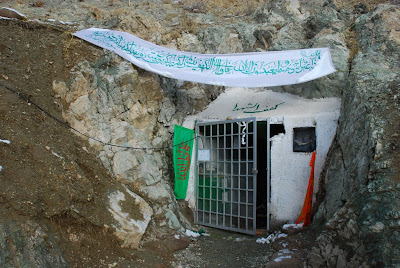
Cave of the Martyrs
The great irony being that though this makeshift monument was intended as a form of public relations, the Basij themselves would be exceedingly sensitive to anyone here taking pictures of it for wider consumption. But the earnest young lad just returned my greeting and went on his way and he was safely out of sight before I ventured a look in the direction from where he had appeared. A workmanlike iron gate, banners with religious slogans hanging limp either side and above it. An entrance to a cell adapted from a natural cave in the mountainside.
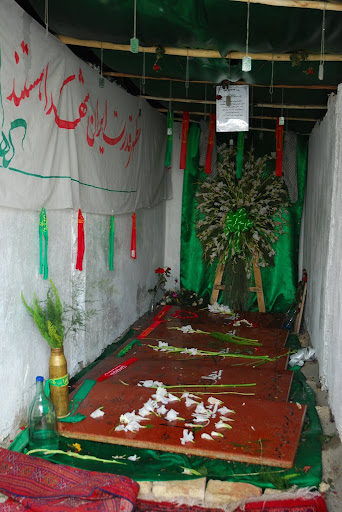
Tehran, Iran.
Cave of the Martyrs
Inside, fading bouquets, petals strewn over three stone slabs laid on the ground. Graves of fallen heroes? An ascetic hermit's cell set aside for solitary mourning and devoted tears.

A few metres away, a low semicircle of sandbags, arranged like a machine-gun bunker, marked off the dead-end path. It guarded a crudely hung nylon banner. On it, a photograph showing Ayatollah Ali Khamenei, standing in reflective mood at the entrance to that very cave.

My cousin later told me of how his father rose early one morning for a mountain walk and witnessed the Supreme Leader emerging from "Kahf al-Shohada" under the cover of the half-light. No fanfare, minimal entourage, perhaps a very personal pilgrimage - but not without leaving photographic evidence to establish the site's status in Basij mythology.

Cave of the Martyrs

© Iranvisitor.com

Tehran Skyline

Tehran Skyline

View of Tehran with Milad Tower
You get some pretty stunning views out over the city from "Baam-e Tehran" (Roof of Tehran) especially at dawn and sunset. From here you also get a good perspective on how breathable the city air is on any given day - mountains visible in the south is a sign that the smog is relatively thin.


Same view, this time with thick, early morning cloud (not smog) smothering the city like a quilt.

Iranian Music CDs

Guide to Tehran

© Iranvisitor.com

Imam Khomeini Airport (IKA)

Imam Khomeini Airport (IKA)

Imam Khomeini Airport (IKA), Tehran
Plans to build IKA existed before 1979 but were put on hold after the Islamic revolution. The airport was eventually opened in 2004 and now almost all international flights have been transferred here from the old Mehrabad Airport in central Tehran.

IKA is situated about 30km south of the city on the road to Qom. With no public transport system yet in place, the only way to get there is by private taxi (120,000 Rials, 1hr, Tel.: 021 88738855)

© Iranvisitor.com

Monday, December 17, 2007

Basij Week in Iran

Basij Week in Iran

Basij Week Tehran

This poster is publicising Basij Week which I think has just ended. You may have heard something about the Basij in the news where you are. Human Rights Watch calls them a "parallel organisation" which pretty well sums up their relationship with the government - they're not under direct control but they provide a loyal pillar of support for it in times of need.

In the past this has involved getting heavy with student protests and enforcing codes of conduct and dress in public places. I remember last year seeing a run-in between a group of Basijis and some young men out for a walk in the mountains. The boys were wearing tight clothes and "fashionable" beards that the Basijis found objectionable and they tried to "arrest" them. I didn't stay to find out what happened.

(NB. The Basij are not responsible for the current minor crackdown on "un-Islamic" dress which is going on around Tehran. Those guys are from Ershad (The Council for Islamic Guidance) which is a full government body. Ershad patrols get real police cars and have much more convincing uniforms.)

One way in which the Basiji make themselves conspicuous is on big group outings. I occasionally see them on the way to or from the mountains near wear I live. Here's a clandestine shot of some women Basiji's taken from inside a bus.

Basij Week Tehran

They were part of a coachload of female members all-wearing white and blue checked scarves which signify their support for the Palestinians. At the head of the procession there will often be a standard-bearer carrying a green flag addressing Imam Hossein - the most important of the Shia martyrs. Male groups often chant military-style marching slogans. This all harks back to the time when Basij members provided much of the raw manpower required to kick the Iraqis out of cities like Khorramshahr - a name which still evokes bitter yet proud memories of a time when Iran really was united against a common enemy.

The Basij are still a major part of Iranian society, but I can't help but think they're becoming more and more anachronistic as the Iraq war recedes further into the past. Though scars are still fresh for veterans and especially the families of the shohada (martyrs), it's getting harder now to convince Iranians that they are still at war.

Basij Week Tehran

Iranian government PR is something of a one-trick pony. Replay footage of the Iran-Iraq war and try to make it feel current by blurring it into recent images of dying Gazans. All the patriotically-inspiring if broadcast at half time during international football matches. But the war footage is looking more and more dated now and superimposing Ayatollah Khamenei over pictures of volunteers who never came back just doesn't ring true. The Palestinian conflict is just too far away to evoke the same power of conviction.

With 50% of Iranians just too young to really remember the war, what the Iranian government needs now is a cause. A truly Iranian sacrifice to once again give the Basij a feeling that their world view - a country under threat and therefore in need of repressive conservatism - is correct. And just the possibility (let's not even consider the actuality) of an attack by the U.S. on Iranian soil is just the ticket.

© Iranvisitor.com

Monday, December 10, 2007

BBQ Corn - Vali Asr

BBQ Corn - Vali Asr

On a quiet weekday evening, there isn't really much going on in the streets of Tehran. Not even on the main strip - Vali-e Asr Street.

Barbequed corn on Vali Asr

But this guy was gamely fanning the flames of his makeshift barbecue and wooing passers-by with the prospect of chargrilled sweetcorn. I'd never had it over coals before, and I still prefer it boiled but it's a fun treat nonetheless especially on a cold autumn evening when you can gather around the hot coals and make small talk with other stray folk.

© Iranvisitor.com

Tuesday, December 04, 2007

Neon signs - Vali Asr

Neon signs - Vali Asr

Don't you just love neon on cold, crisp evenings? The shop below is photocopy and print shop and above it is the phone number of a travel agency consisting only of 7s and 8s.

Neon signs - Vali Asr, Tehran

Iranian Music CDs

Guide to Tehran

© Iranvisitor.com

Friday, November 30, 2007

Persimmons in Tehran

Persimmons in Tehran

Seasonal fruit is a great pleasure. There's so much tasteless imported produce in western (and Japanese) supermarkets that probably not that many people know what the right season for most fruit is. But I think Iran is pretty much self-sufficient when it comes to fruit and veg and I certainly look forward to autumn for several of my favourites - one of which is the persimmon which I've heard called "Sharon fruit" before, "kaki" in Japan and "khormaloo" in Iran. Khorma is the Farsi word for "dates" and aloo means "plum."

Persimmons

I wonder if there's a connection there with the Hindi(?) word for potato - something like the French calling them "pommes de terre." Anyway "khormaloo" is a word loaded with sweet winter connotations for me, the colour itself is enough to warm your hands and the sight of abundant orange fruit weighing down leaveless branches and punctuating the air with their fat jolliness is a sure-fire way to put a smile on my face. I think Santa Claus should wear persimmon orange.

Books on Iran

Guide to Tehran

© Iranvisitor.com

Wednesday, October 24, 2007

Iran Tube

Iran Tube

Iran Tube is the Iranian equivalent of YouTube.

Members can upload Iran-related videos. Categories include news, sports, travel and popular culture.

Iran Tube

Iranian Music CDs

Guide to Tehran

© IranVisitor.com