Tourist & Resident Guide to Iran

Friday, December 21, 2007

Cave of the Martyrs

Cave of the Martyrs

For the last few months I've been wondering what the green halogen lights leading up the mountainside were for. Alien landing site? Late night mining operations? There was nothing obvious from down below but one day I noticed a new street sign pointing up the hill. The white on brown colour scheme denoting something of cultural interest.

Cave of the Martyrs
Cave of the Martyrs
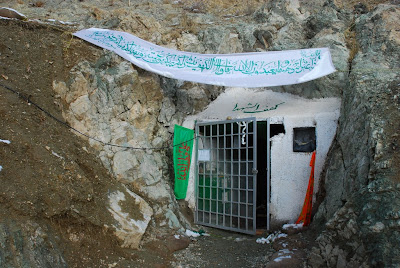
A thin layer of crisp snow lay on the ground the morning I decided to make my way up. I followed the icy dirt path in unsuitable shoes. Paw tracks showed me that the local strays had been up and down before dawn. A long, white goods container had been deposited on a level area half way up. Green-painted frame borders with "Kahf al-Shohada" (Cave of the Martyrs), brushed on in vivid blood-red spoke of the grief-fuelled nationalism so fundamental to current power structures. Open air martyr-worship in a country where the politico-religious establishment has a strict monopoly on public expression.

Further up was a slightly wider but equally anticlimatic plateau. More red, white and green. Iranian flags, makeshift spotlighting planted in the ground at incongruous angles. I heard the creak of a hinge and shuffling behind me and a lanky, young Basij boy, crewcut, unshaven, with regulation Palestinian check scarf, emerged from apparently nowhere. An inner voice told me my presence was not wanted. I swung my camera behind my arm offered a guilt-ridden "good morning." Political repression clearly having left its mark on my conscience.
Cave of the Martyrs
The great irony being that though this makeshift monument was intended as a form of public relations, the Basij themselves would be exceedingly sensitive to anyone here taking pictures of it for wider consumption. But the earnest young lad just returned my greeting and went on his way and he was safely out of sight before I ventured a look in the direction from where he had appeared. A workmanlike iron gate, banners with religious slogans hanging limp either side and above it. An entrance to a cell adapted from a natural cave in the mountainside.
Tehran, Iran.
Cave of the Martyrs
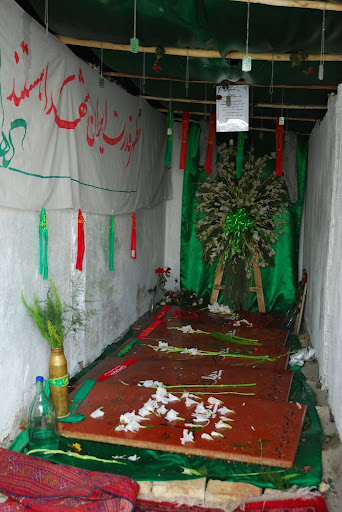
Inside, fading bouquets, petals strewn over three stone slabs laid on the ground. Graves of fallen heroes? An ascetic hermit's cell set aside for solitary mourning and devoted tears.

A few metres away, a low semicircle of sandbags, arranged like a machine-gun bunker, marked off the dead-end path. It guarded a crudely hung nylon banner. On it, a photograph showing Ayatollah Ali Khamenei, standing in reflective mood at the entrance to that very cave.

My cousin later told me of how his father rose early one morning for a mountain walk and witnessed the Supreme Leader emerging from "Kahf al-Shohada" under the cover of the half-light. No fanfare, minimal entourage, perhaps a very personal pilgrimage - but not without leaving photographic evidence to establish the site's status in Basij mythology.

Cave of the Martyrs

© Iranvisitor.com

Tehran Skyline

Tehran Skyline

View of Tehran with Milad Tower
You get some pretty stunning views out over the city from "Baam-e Tehran" (Roof of Tehran) especially at dawn and sunset. From here you also get a good perspective on how breathable the city air is on any given day - mountains visible in the south is a sign that the smog is relatively thin.


Same view, this time with thick, early morning cloud (not smog) smothering the city like a quilt.

Iranian Music CDs

Guide to Tehran

© Iranvisitor.com

Imam Khomeini Airport (IKA)

Imam Khomeini Airport (IKA)

Imam Khomeini Airport (IKA), Tehran
Plans to build IKA existed before 1979 but were put on hold after the Islamic revolution. The airport was eventually opened in 2004 and now almost all international flights have been transferred here from the old Mehrabad Airport in central Tehran.

IKA is situated about 30km south of the city on the road to Qom. With no public transport system yet in place, the only way to get there is by private taxi (120,000 Rials, 1hr, Tel.: 021 88738855)

© Iranvisitor.com

Monday, December 17, 2007

Basij Week in Iran

Basij Week in Iran

Basij Week Tehran

This poster is publicising Basij Week which I think has just ended. You may have heard something about the Basij in the news where you are. Human Rights Watch calls them a "parallel organisation" which pretty well sums up their relationship with the government - they're not under direct control but they provide a loyal pillar of support for it in times of need.

In the past this has involved getting heavy with student protests and enforcing codes of conduct and dress in public places. I remember last year seeing a run-in between a group of Basijis and some young men out for a walk in the mountains. The boys were wearing tight clothes and "fashionable" beards that the Basijis found objectionable and they tried to "arrest" them. I didn't stay to find out what happened.

(NB. The Basij are not responsible for the current minor crackdown on "un-Islamic" dress which is going on around Tehran. Those guys are from Ershad (The Council for Islamic Guidance) which is a full government body. Ershad patrols get real police cars and have much more convincing uniforms.)

One way in which the Basiji make themselves conspicuous is on big group outings. I occasionally see them on the way to or from the mountains near wear I live. Here's a clandestine shot of some women Basiji's taken from inside a bus.

Basij Week Tehran

They were part of a coachload of female members all-wearing white and blue checked scarves which signify their support for the Palestinians. At the head of the procession there will often be a standard-bearer carrying a green flag addressing Imam Hossein - the most important of the Shia martyrs. Male groups often chant military-style marching slogans. This all harks back to the time when Basij members provided much of the raw manpower required to kick the Iraqis out of cities like Khorramshahr - a name which still evokes bitter yet proud memories of a time when Iran really was united against a common enemy.

The Basij are still a major part of Iranian society, but I can't help but think they're becoming more and more anachronistic as the Iraq war recedes further into the past. Though scars are still fresh for veterans and especially the families of the shohada (martyrs), it's getting harder now to convince Iranians that they are still at war.

Basij Week Tehran

Iranian government PR is something of a one-trick pony. Replay footage of the Iran-Iraq war and try to make it feel current by blurring it into recent images of dying Gazans. All the patriotically-inspiring if broadcast at half time during international football matches. But the war footage is looking more and more dated now and superimposing Ayatollah Khamenei over pictures of volunteers who never came back just doesn't ring true. The Palestinian conflict is just too far away to evoke the same power of conviction.

With 50% of Iranians just too young to really remember the war, what the Iranian government needs now is a cause. A truly Iranian sacrifice to once again give the Basij a feeling that their world view - a country under threat and therefore in need of repressive conservatism - is correct. And just the possibility (let's not even consider the actuality) of an attack by the U.S. on Iranian soil is just the ticket.

© Iranvisitor.com

Monday, December 10, 2007

BBQ Corn - Vali Asr

BBQ Corn - Vali Asr

On a quiet weekday evening, there isn't really much going on in the streets of Tehran. Not even on the main strip - Vali-e Asr Street.

Barbequed corn on Vali Asr

But this guy was gamely fanning the flames of his makeshift barbecue and wooing passers-by with the prospect of chargrilled sweetcorn. I'd never had it over coals before, and I still prefer it boiled but it's a fun treat nonetheless especially on a cold autumn evening when you can gather around the hot coals and make small talk with other stray folk.

© Iranvisitor.com

Tuesday, December 04, 2007

Neon signs - Vali Asr

Neon signs - Vali Asr

Don't you just love neon on cold, crisp evenings? The shop below is photocopy and print shop and above it is the phone number of a travel agency consisting only of 7s and 8s.

Neon signs - Vali Asr, Tehran

Iranian Music CDs

Guide to Tehran

© Iranvisitor.com

Friday, November 30, 2007

Persimmons in Tehran

Persimmons in Tehran

Seasonal fruit is a great pleasure. There's so much tasteless imported produce in western (and Japanese) supermarkets that probably not that many people know what the right season for most fruit is. But I think Iran is pretty much self-sufficient when it comes to fruit and veg and I certainly look forward to autumn for several of my favourites - one of which is the persimmon which I've heard called "Sharon fruit" before, "kaki" in Japan and "khormaloo" in Iran. Khorma is the Farsi word for "dates" and aloo means "plum."

Persimmons

I wonder if there's a connection there with the Hindi(?) word for potato - something like the French calling them "pommes de terre." Anyway "khormaloo" is a word loaded with sweet winter connotations for me, the colour itself is enough to warm your hands and the sight of abundant orange fruit weighing down leaveless branches and punctuating the air with their fat jolliness is a sure-fire way to put a smile on my face. I think Santa Claus should wear persimmon orange.

Books on Iran

Guide to Tehran

© Iranvisitor.com

Wednesday, October 24, 2007

Iran Tube

Iran Tube

Iran Tube is the Iranian equivalent of YouTube.

Members can upload Iran-related videos. Categories include news, sports, travel and popular culture.

Iran Tube

Iranian Music CDs

Guide to Tehran

© IranVisitor.com

Saturday, September 22, 2007

Afshin Ghotbi to Persepolis

Afshin Ghotbi to Persepolis

Afshin Ghotbi recently left his job as South Korea's national team assistant coach to return to Iran to coach Iranian giants Persepolis.

Afshin GhotbiBorn in Iran, the 43-year-old left his homeland for America in 1977 and went to the 1998 World Cup with the United States and the 2002 and 2006 World Cups with South Korea.

How do you feel about leaving Korea for Iran?
I think I am numb at this moment. I feel excited because of a new challenge and going back to my home country that I haven't seen for 30 years. I also feel sadness because I have so many memories in Korea and so many experiences. It's hard to leave the Korean players as I am always impressed by their mentality and their willingness to learn.

I am excited because I will be head coach of a team and more than that the biggest club in Iran and probably one of the biggest in Asia. They have such history and I remember that as a child. Even when I was a little boy playing in the street, it was always the Reds (Persepolis) against the Blues (Esteghlal).

Read the rest of the Afshin Ghotbi interview here

Iranian Music CDs

Guide to Tehran

Saturday, August 11, 2007

Iran on YouTube

Iran on You Tube

If you typed in "Iran" on YouTube in 2007 coming up No. 1 was a tribute to the country.

The music was by Faramarz Aslani "age ye rooz" - however the video is no longer available due to a copyright claim by Pars video. So instead here is a video by Anthony Bourdain as he samples the delights of Persian cuisine in such dishes as Dizi, Fesenjan, Biryani, and Tahdig.

Iranian Music CDs

Guide to Tehran

© IranVisitor.com

Thursday, July 19, 2007

Iran Reach Asian Cup Second Round

Iran Reach Asian Cup Second Round

Iran Reach Asian Cup Second Round
Iran beat co-hosts Malaysia in Kuala Lumpur to reach the quarterfinals of the Asian Cup as winners of Group C.

Iran scored once in each half to set up a match with South Korea in Kuala Lumpur on Sunday.

Javad Nekounam scored from the penalty spot after 29 minutes and Andranik Teymourian added a fine individual goal ten minutes from time.

Iranian Music CDs

Guide to Tehran

© Iranvisitor.com

Wednesday, June 20, 2007

Kashan Mansions

Kashan Mansions

Kashan is known for its beautiful, restored mansions. They seem to rise out of the earth.

Kashan traditional house

Guide to Tehran

© Iranvisitor.com

Friday, June 08, 2007

Still Incomplete Milad Tower

Still Incomplete Milad Tower

Still Incomplete Milad Tower.

The still incomplete Milad Tower looks out over one of Tehran's busy public transport junctions.

Finally completed in October 2008, the Milad Tower (Borj-e Milād) is Tehran's iconic, 435-meter-tall multi-purpose tower, serving as a major telecommunications hub, cultural center, and tourist attraction, featuring observation decks, restaurants (including a revolving one), museums, and various entertainment facilities, making it the tallest tower in Iran and a symbol of modern Tehran.

Guide to Tehran

© Iranvisitor.com

Existential graffiti in Iran

Existential graffiti in Iran

Existential graffiti in Iran.


Roughly translated:

I write to leave a reminder
So that if I disappear one day
A reminder it will stay

Guide to Tehran

© Iranvisitor.com

Thursday, June 07, 2007

"Eeenja Iran-e!" (This is Iran!)

"Eeenja Iran-e!" (This is Iran!)

This is an excuse I hear a lot when things are not the way they should be. It's usually employed once a solution to a problem is identified and thoughts turn to putting it into practice.

This is Iran!

"But this is Iran!" It's not as easy as that! Sure, that's the problem and this is the best way to get around it but this is Iran. Don't expect things to go so well....

[ followed by any/all of Iran's 3 great national excuses.]

1. First of all people 'don't have culture' here [the Farsi word for this is 'bifarhang' which has no direct translation] they don't know how to behave. You tell them one thing and they do another. They're uneducated and they don't know how to follow rules....

2. And the government doesn't let people get on with their lives. One day one politician launches a policy, the next day he's gone and his replacement wants something else. He gives government jobs to all his cronies and they start filling their pockets and before they've had enough so they can really start work their boss gets the sack and another politician/set of cronies starts all over again!

3. Do you expect the West would let us improve? We were developing a perfectly good democracy until the US stepped in and took away the only decent leader we'd had since Abbas the Great [meaning Mohammad Mossadegh]. And the British are twice as cunning.... Everyone knows George Bush is in Tony Blair's pocket. The mullahs all take their orders from England. It's been like that for centuries and don't think it's going to change soon!

Guide to Tehran

© Iranvisitor.com

Monday, May 21, 2007

Uptown Real Estate Tehran

Uptown Real Estate Tehran

Uptown Tehran

Another pic from the rooftops. This is uptown Tehran. You can make out the slope up to the Alborz mountain range in the background. Basically, if you have the money, you get cleaner air. But Tehran real estate is prohibitively expensive for most Iranians and prices just get higher. And so do the construction projects. Here's a tower block going up on Afriqa Avenue (also known as Jordan) - a fashionable, traffic-clogged boulevard flanked by some of the most expensive property in the country.

Guide to Tehran

© Iranvisitor.com

Tehran From Above

Tehran From Above

Tehran from above
On a clear day you can see mountains from everywhere in Tehran.

Guide to Tehran

Saturday, May 12, 2007

More Japanese Visit Iran in 2007

More Japanese Visit Iran in 2007


More and more Japanese are planning to visit Iran in 2007, according to PressTV.

More Japanese Visit Iran in 2007

More Japanese Visit Iran in 2007

More Japanese Visit Iran in 2007


Guide to Tehran

Tuesday, May 08, 2007

Nuclear banknote

Nuclear banknote


Iran's central bank has issued a 50,000 Rial note with a nuclear symbol motif.


The back of the note features a symbol representing electrons circling a nucleus superimposed over the map of Iran. Alongside it is a quote from the Prophet Mohammad which runs, ""if the science exists in this constellation, men from Persia will reach it."

Guide to Tehran

© Iranvisitor.com

Saturday, May 05, 2007

Giveh: Iranian summer footwear

Giveh: Iranian summer footwear

Giveh: Iranian summer footwear.

Just in time for summer, I've bought myself a pair of giveh, the ideal shoes for the long, hard Tehran summer. Giveh have been made for centuries in many parts of Iran but are most famously from Western Iran, particularly a town called Paveh in Kermanshah Province.

The upper is made of strong tightly woven cotton sewn tight to (on my pair) a leather sole. The soles of traditional are made of tightly compacted layers of cotton material stacked from toe to heel. These are less practical since they can lose their shape if wet.

Giveh are, however, very much dry weather footwear. Made almost entirely from cotton, there's no need to wear socks and feet breath easily. In fact, in the town where my giveh were made they are referred to as jurab (socks) rather than kafsh (shoes).

Isfahan Weather

Tehran Weather

Guide to Tehran

© Iranvisitor.com